



You’re likely thinking more about your indoor air quality. Traditional purifiers are a start, but air purification in 2025 goes beyond just machines. Roughly 33% of the global population faces indoor air pollution issues. Innovative air-purifying paints are a game-changer, actively improving your home’s air quality for healthier living.
Key Takeaways
Air-purifying paints use special ingredients to clean your indoor air. These paints break down harmful chemicals like VOCs and formaldehyde.
Choosing an air purifier means looking at its CADR rating for room size. Also, check filter replacement costs and how noisy it is.
Smart air purifiers connect to your phone and adjust settings automatically. They help you keep track of your home’s air quality easily.
Understanding Your Air Quality Needs
Before you choose any purification method, you need to understand what you are up against. What exactly is lurking in your home’s air? Knowing this helps you pick the right solutions for better air quality.
Identifying Common Indoor Pollutants
Many things can pollute your indoor air. You might find volatile organic compounds (VOCs) from paints, cleaning products, and even new furniture. Formaldehyde, another common culprit, comes from carpets and pressed wood. Radon, an invisible gas, can seep up from the ground. Other common pollutants include pet dander, dust, and biological agents like mold and bacteria. These contaminants can seriously impact your health. They often irritate your eyes, nose, and throat. Long-term exposure can lead to respiratory issues, worsen asthma, and even contribute to conditions like COPD. For example, humidity and dampness promote mold growth, which directly links to respiratory disorders.
Assessing Your Home Environment
Now, think about your home. Do you have pets? Does anyone smoke indoors? What about the size of your rooms? These factors all influence your specific air quality needs. You can assess your indoor air quality in a few ways. You might contact professionals for a complete indoor air quality test. They can give you a detailed breakdown of any issues. Another option is to use free online assessment tools. These tools ask about your home’s ventilation, potential pollution sources, and even health symptoms. Based on your answers, they provide an immediate risk assessment and tailored recommendations to improve your air quality.
Types of Air Purifiers and Their Function
Understanding different air purifier types helps you choose the best one. Each cleans your air uniquely.
HEPA Filters: Particle Removal
You’ve likely heard of HEPA filters. A hepa air purifier excels at trapping tiny particles. A true hepa filter catches airborne particles via impaction (larger particles hit fibers), diffusion (smaller particles bounce and stick), and interception (particles following airstream get caught). This effectively removes dust, pollen, and pet dander.
Activated Carbon Filters: Odor and VOCs
What about smells and chemicals? An activated carbon filter is your go-to. This filter absorbs gases and odors. An activated carbon filter excels at removing VOCs from paints and cleaning supplies, plus smoke, cooking smells, and formaldehyde. Combining a true hepa filter with an activated carbon filter creates a powerful duo.
UV-C Purifiers: Germs and Viruses
Germs and viruses are another concern. UV-C purifiers use ultraviolet light to zap these tiny invaders. As air passes through, UV-C light hits microorganisms, breaking their DNA bonds. This stops them from causing harm.
Ionizers and Ozone Generators
Ionizers release charged particles, making pollutants stick. Ozone generators create ozone, a harmful gas. Ozone irritates your respiratory system, causing coughing or chest tightness. It can even damage your lungs. Avoid ozone generators.
Whole-Home vs. Portable Units
Should you get a whole-home system or a portable one? Portable units are great for specific rooms, offering flexibility. Whole-home systems integrate with your HVAC, cleaning air throughout your house. Consider your budget and needs. For targeted relief, a portable hepa air purifier with a true hepa filter and an activated carbon filter is often a great start.
Innovative Air Purification Solutions for 2025
Your home’s fight against pollutants is getting smarter and more integrated. Beyond traditional machines, new technologies offer exciting ways to boost your indoor air quality.
Air-Purifying Paint: A New Frontier
Imagine your walls actively cleaning the air. Specialized air-purifying paints do just that! These paints use photocatalysis, a natural reaction. Tiny titanium dioxide nanoparticles in the paint act as catalysts. When sunlight hits them, they release electrons. These electrons then interact with humidity, creating highly reactive hydroxyl radicals. These radicals attack pollutant molecules, turning them into harmless substances. This process effectively neutralizes pollutants like VOCs and formaldehyde. Some paints, like BANDě, go further. They can neutralize NO2, kill 99.9% of human coronavirus, SARS, and influenza, and even stop mold growth. They also contain no VOCs themselves, ensuring better air quality from the start.
Smart Home and AI Purifiers
Technology makes air purification easier and more effective. Smart purifiers constantly monitor your air quality in real-time. You can control them remotely from your phone. They even optimize energy use, running harder when needed and saving power when the air is clean. AI-driven systems learn your preferences, adjusting settings like humidity and temperature for personalized wellness. These devices can integrate with your entire smart home, even optimizing your HVAC system for superior air quality.
Air-Purifying Plants: Natural Limits
Plants offer a natural touch to your home, and they do help a little. NASA studies from the 1980s showed that common houseplants can remove some pollutants. For example, a Warneck dracaena removed formaldehyde, and chrysanthemums tackled trichloroethylene. The roots and soil microorganisms play a big role in this process. However, while plants contribute to a healthier environment, they cannot significantly improve overall air quality on their own, especially in larger spaces or with high pollutant levels. Think of them as a nice addition, not your primary air-purifying solution.
Choosing the Best Air Purifier in 2025
Choosing the right air purifier can feel overwhelming with so many options available. You want to make an informed decision for your home’s air quality. Let’s break down the key factors you should consider.
CADR: Understanding the Numbers
When you look at air purifiers, you will often see a CADR rating. CADR stands for Clean Air Delivery Rate. It measures the volume of clean air a purifier produces, expressed in cubic feet per minute (CFM). This number tells you how quickly the purifier can remove pollutants from a room. Higher CADR values mean faster and more efficient air purification.
CADR tests are quite complex. They involve a particle monitor, a sealed 30m³ test lab, and tightly controlled conditions. While a simpler shortcut might multiply an air purifier’s airflow by its filtration efficiency, this method can differ from actual CADR test numbers. It doesn’t account for factors like air mixing in a real room or how filtration efficiency changes with air speed.
You will typically see three CADR values: one for dust, one for pollen, and one for smoke. These represent the purifier’s effectiveness against each particle type. To choose the right size, you should aim for a CADR that covers at least two-thirds of your room’s area. For example, if you have a 500 sq. ft. room, you need a purifier with a strong CADR. The Levoit Core 600S, with a CADR rating of 410 CFM, works well for rooms up to 635 sq. ft. It purifies the air 4.8 times per hour in a 500 sq. ft. space. Another option, the Honeywell HPA5300 InSight™ HEPA Air Purifier, offers CADR ratings of 323 for tobacco smoke, 335 for dust, and 335 for pollen for a 500 sq. ft. room. Always match the CADR to your recommended room size for optimal performance.
Filter Life and Replacement Costs
An air purifier is an investment, and you need to consider the ongoing costs. Filters don’t last forever, and you will need to replace them regularly to maintain good air quality.
Filter Type | |
|---|---|
HEPA Filters | 6 to 12 months |
Activated Carbon | 3 to 6 months |
Main air purifier filters typically range from $20 to over $200 each. Activated carbon filters, often used for odor removal, may need replacement every three months and can cost up to $50 per filter. These costs add up. For instance, an Intellipure Compact Annual Filter Set costs $288.77, while a Delos AMA 100 Annual Kit is $169.00.
Here’s a look at some annual filter costs for popular models:
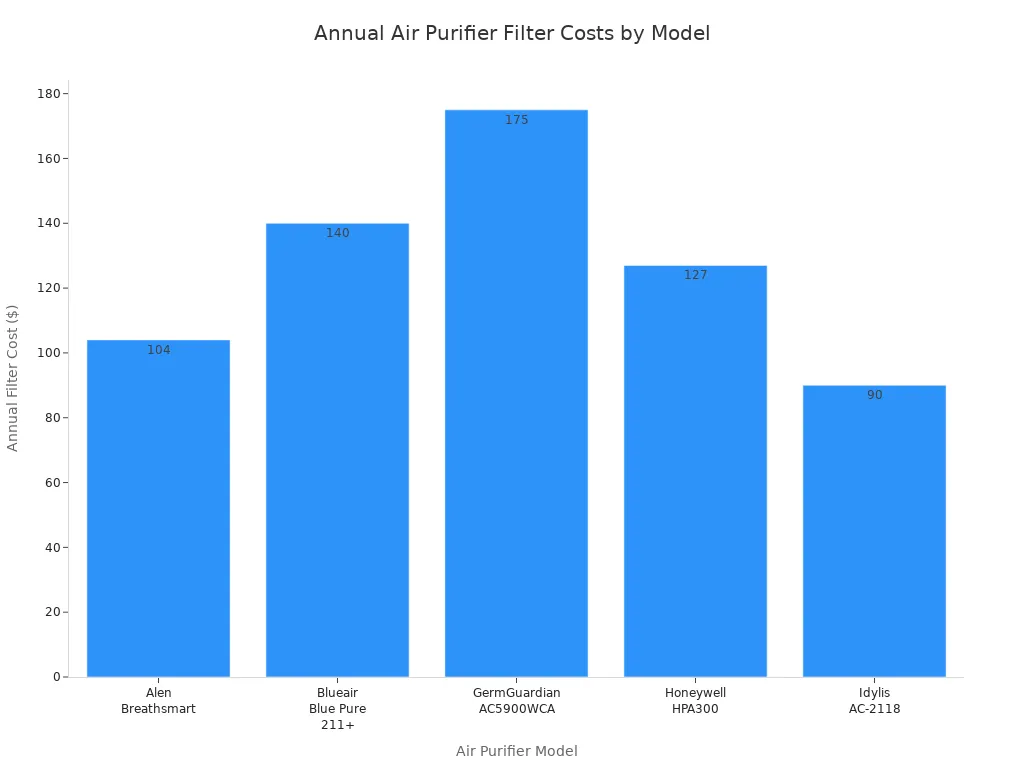
You should factor these filter replacement costs into your budget when you choose a purifier.
Noise Levels and Energy Efficiency
Nobody wants a noisy appliance, especially in a bedroom or living area. You should pay attention to the noise level in decibels (dBA) when selecting an air purifier. Air purifiers are tested at fan speeds that generate less than 45 decibels of sound. This level is suitable for bedrooms and other quiet environments. Based on extensive testing, a noise level between 40 and 45 dBA is comfortable and perfectly acceptable for everyday use. This ensures quiet operation, allowing you to sleep or work undisturbed.
Energy efficiency is another crucial factor. An air purifier runs for many hours, so you want one that won’t significantly increase your electricity bill. Look for models with an Energy Star rating. Energy Star certified room air purifiers are approximately 27% more energy-efficient than standard, non-certified models. This means significant savings over time.
Here are some examples of annual energy use for various models:
Model Name | Room Size (sq.ft.) | Annual Energy Use (kWh/yr) |
|---|---|---|
Rainbow – Luggable XL Ultra | 516 | 81 |
Rainbow – Luggable XXL | 474 | 75 |
Rainbow – Exhalaron Ultra Tri | 172 | 42 |
Blueair – 4312111000 | 705 | 235 |
Choosing an Energy Star model ensures better energy efficiency and lower operating costs for maintaining good air quality.
Additional Features
Beyond the core purification capabilities, many air purifiers offer extra features that enhance your user experience. These can make a big difference in how convenient and effective your unit is.
Look for smart functions that allow you to control the purifier from your phone. App support often provides detailed air quality data, letting you see exactly what your purifier is doing. Onboard air quality sensors are excellent; they detect pollutants and automatically adjust fan speeds, ensuring optimal air quality without constant manual intervention. Remote controls offer convenience, letting you change settings from across the room. For bedrooms, a no-lights mode is a fantastic feature, preventing bright displays from disturbing your sleep. These additional features contribute to a more seamless and effective air purification strategy in your home.
Top Air Purifier Recommendations for 2025
You have learned a lot about what makes a great air purifier. Now, let’s look at some of the top models available in 2025. These recommendations will help you choose the perfect device for your specific needs, ensuring you get the best air quality possible.
Best for Large Spaces
If you have a big open-plan living area or a spacious bedroom, you need a powerful air purifier. You want a unit that can handle a large volume of air quickly and efficiently.
Coway Airmega ProX: This model stands out for its exceptional performance. It clears dust, pollen, and smoke effectively, even at varying speeds. You can use it in spaces up to 2,126 square feet. It also boasts excellent noise scores, meaning it won’t disrupt your peace. It comes with three speeds, a filter indicator, and a dirt sensor. Many users report high satisfaction and reliability with this unit.
AirDoctor AD5500: This air purifier also excels at clearing dust, pollen, and smoke when running at high speeds. It is easy to use. However, it can get loud at its highest settings, and its performance at lower, quieter speeds is only average. This model is one of the more expensive options to buy and operate, with annual costs around $332. Still, owners give it high marks for reliability and satisfaction.
Blueair Blue Pure 311i+ Max: This portable unit is great for large spaces between 350 to 650 square feet. It effectively removes dust, pollen, and smoke at higher settings, though it can be noisy. You will find it offers near top-level results at lower, quieter speeds. It includes a filter indicator, a dirt sensor, and four speeds. It is lightweight, weighing only 8 pounds, and costs about $128 annually to maintain. Blueair purifiers are highly reliable and satisfying for many users.
You can also check out lists like RTINGS.com’s “The 4 Best Large Room Air Purifiers of 2025” for more options.
Best for Odor Control
Odors from cooking, pets, or chemicals can significantly impact your home’s air quality. You need an air purifier specifically designed to tackle these smells.
Activated carbon filters are crucial for odor removal. They capture volatile organic compounds (VOCs) and other odor-causing chemical compounds through a process called adsorption. Unlike HEPA filters, which remove particles, activated carbon has a massive surface area with microscopic holes that act like a sponge, trapping these chemical compounds. This molecular filtration is necessary to effectively neutralize odors from sources like smoke, cooking, pets, and chemical fumes.
Austin Air HealthMate: This is a top recommendation for odors. It features a substantial filter with 15 pounds of carbon and zeolite mix. This powerful combination effectively adsorbs a wide range of chemical fumes and odors, significantly improving your air quality.
Key Features for Odor Control:
Activated Carbon or Carbon/Zeolite Filters: These are essential for removing odors, as HEPA filters alone do not capture smells. They neutralize VOCs and other odor-causing chemical compounds through adsorption.
Clean Air Delivery Rate (CADR): The CADR must be sufficient for your room size to ensure effective odor removal. Proper placement of the air purifier is also crucial for optimal performance.
Filter Replacement Indication: This feature is essential for timely maintenance, ensuring your air purifier continues to effectively fight odors.
Smart Features: Timers, remote control, and smart connectivity can enhance the overall usability of your odor-fighting air purifier.
Best Value and Overall Performance
You want a great air purifier that delivers excellent performance without breaking the bank. These models offer a fantastic balance of effectiveness and affordability.
Coway Airmega AP-1512HH Mighty: This model consistently appears on “best of” lists and is one of the best air purifiers tested. It covers rooms up to 361 square feet and features a four-stage filtration system. In performance tests, it achieved outstanding results, improving air quality by about 96% in 60 minutes in a 320 square foot room. Despite a less ideal power-to-CADR ratio, it operates quietly at lower speeds. Given its affordable price and strong performance, especially against airborne allergens, you will find it a worthwhile option for balancing performance and value.
Winix 5500-2: This is often cited as the best value air purifier. It offers a comprehensive filtration system, including a true HEPA filter, an activated carbon filter, and PlasmaWave technology, which helps break down pollutants at a molecular level. It provides excellent performance for its price point, making it a smart choice for many homes.
Smart and Comprehensive Options
For those who love technology and seamless integration, smart air purifiers offer convenience and advanced control. These units connect to your home network, giving you more power over your indoor air quality.
Levoit Core 400S: This model is the ‘Smart Home Champion’ for 2025, perfect for tech-savvy users. It boasts strong 3-stage filtration, good performance covering up to 403 square feet, and quiet operation. Its comprehensive smart features include full app control, scheduling, air quality tracking, and compatibility with Alexa/Google. An auto mode adjusts fan speed based on PM2.5 levels, and it offers sleep-friendly options. This model is a smart, quiet, and powerful purifier with excellent app features, suitable for modern users seeking both performance and convenience.
General Smart Features: Many contemporary air purifiers offer Wi-Fi connectivity and companion smartphone apps. These apps provide remote operation and customized cleaning schedules. They also offer detailed air quality history and accurate filter life monitoring. Voice control via smart assistants like Amazon Alexa or Google Assistant adds hands-free convenience. These features are highly valuable for users who appreciate smart home integration and data-rich feedback.
HisoAir’s Wall-Mounted Air Purifiers: These units offer smart control via Wi-Fi and compatibility with smart home protocols. They provide a sleek, modern aesthetic, save floor space, and feature ultra-sensitive smart sensing and advanced filtration.
Levoit Vital 100S: This model also features smart app functionality and voice control capabilities. It is best suited for ‘Smart Home Integration’ if you are looking for a more compact smart option.
Your best air purification strategy is personal. You need a multi-pronged approach. Understand your specific needs, then explore traditional purifiers and innovative solutions like BANDě air-purifying paint. Consider long-term costs and features. Take proactive steps for better indoor air quality and overall well-being.
FAQ
How does air-purifying paint actually work?
Special paints use titanium dioxide. Sunlight activates it. This breaks down pollutants like VOCs and formaldehyde into harmless substances. Your walls actively clean the air.
Can houseplants really clean my air effectively?
Plants help a little. They remove some pollutants. However, they are not enough for significant air purification in larger spaces. Think of them as a nice bonus. 🪴
How do I know which air purifier is best for my home?
Consider your room size and specific pollutants. Look at CADR ratings. Factor in filter costs and noise levels. Choose a model that fits your needs and budget.
See Also
Inorganic Coatings: The Healthy Air-Purifying Choice for Kids’ Rooms
Discovering Inorganic Anion Wall Paint for Healthier Homes in 2025
The Science Behind Inorganic Anion Wall Paints: A 2025 Revelation
Stop Peeling Paint: The Crucial Role of Alkali-Resistant Primer
Achieve a Healthy, Eco-Friendly Home With Inorganic Seven-Color Coating
