


Negative ions are invisible molecules, abundant in natural settings like waterfalls and forests. Scientists now incorporate these beneficial ions into everyday materials, specifically inorganic paints. This blog explores the science, generation, and benefits of negative ion inorganic paint. These innovative paints offer transformative potential for creating healthier indoor environments.
Key Takeaways
Inorganic paint uses natural minerals to release negative ions into your indoor air continuously.
Negative ions clean the air by pulling dust, pollen, and odor molecules down to the ground.
Painted rooms improve your health by boosting your mood, alertness, and sleep quality.
Science of Negative Ion Generation in Inorganic Paint
What Are Negative Ions?
Negative ions are atoms or molecules that have gained one or more extra electrons. This gives them a net negative electrical charge. Conversely, positive ions have lost electrons, carrying a net positive charge. Air molecules, such as oxygen, often become negatively charged. These charged particles are invisible and odorless. They exist naturally in various environments. Scientists often refer to them as “vitamins of the air” due to their perceived health benefits.
Natural Ion Generation Mechanisms
Nature produces negative ions through several mechanisms. Cosmic rays and lightning strikes generate significant amounts of these ions. The friction of water molecules also creates them. This occurs near waterfalls, ocean waves, and even during rainfall. Plants release negative ions during photosynthesis. These natural processes contribute to the refreshing feeling people experience in these environments. The presence of these ions helps to purify the air.
Piezoelectric and Pyroelectric Effects
Certain inorganic materials possess unique properties that allow them to generate negative ions. The piezoelectric effect describes a material’s ability to generate an electric charge when mechanical stress is applied. For example, pressure or vibration can cause this effect. The pyroelectric effect involves generating an electric charge when the material experiences a change in temperature. Tourmaline, a common mineral, exhibits both piezoelectric and pyroelectric properties. When incorporated into paint, these materials can release electrons into the surrounding air. This process contributes to the formation of negative ions. The internal structure of these minerals facilitates this electron release.
Water Ionization and Mineral Interactions
Water plays a crucial role in negative ion generation within inorganic paints. Many inorganic minerals, when exposed to water molecules, can facilitate their ionization. Water molecules can split into hydrogen ions (H+) and hydroxyl ions (OH-). Certain minerals in the paint act as catalysts. They promote the formation of negatively charged free hydroxyl groups. These hydroxyl groups then interact with air and water molecules. This interaction stimulates the production of negative oxygen ions. This mechanism is particularly effective in environments with some humidity. The paint’s mineral composition directly influences this process.
Semiconductor Properties and Ion Release
Some inorganic materials used in paint formulations exhibit semiconductor properties. Semiconductors have a unique ability to conduct electricity under specific conditions. When these materials absorb energy, such as from light or heat, they can release electrons. These free electrons then attach to neutral air molecules, primarily oxygen. This attachment forms negative oxygen ions. Titanium dioxide, a common pigment in paints, can act as a photocatalyst. It uses light energy to initiate chemical reactions, including electron release. This property makes it a valuable component in negative ion inorganic paint. The controlled release of electrons from these semiconductor materials ensures a continuous supply of negative ions.
Engineering Negative Ion Inorganic Paint for Optimal Release
Key Inorganic Materials for Ion Generation
Developing effective negative ion inorganic paint requires careful selection of materials. Tourmaline powder stands out as a primary choice. This mineral naturally possesses both piezoelectric and pyroelectric properties. These properties allow tourmaline to generate a spontaneous electric field. This field helps release electrons into the surrounding air. The electrons then attach to air molecules, forming negative ions.
Manufacturers incorporate tourmaline into paint formulations as a fine powder. Its unique crystalline structure creates a constant, low-level electrical charge. This charge does not require external power. This makes tourmaline an ideal passive ion generator for paints. The consistent electron emission contributes to a stable supply of negative ions in the painted environment.
Enhancing Ion Release Capacity
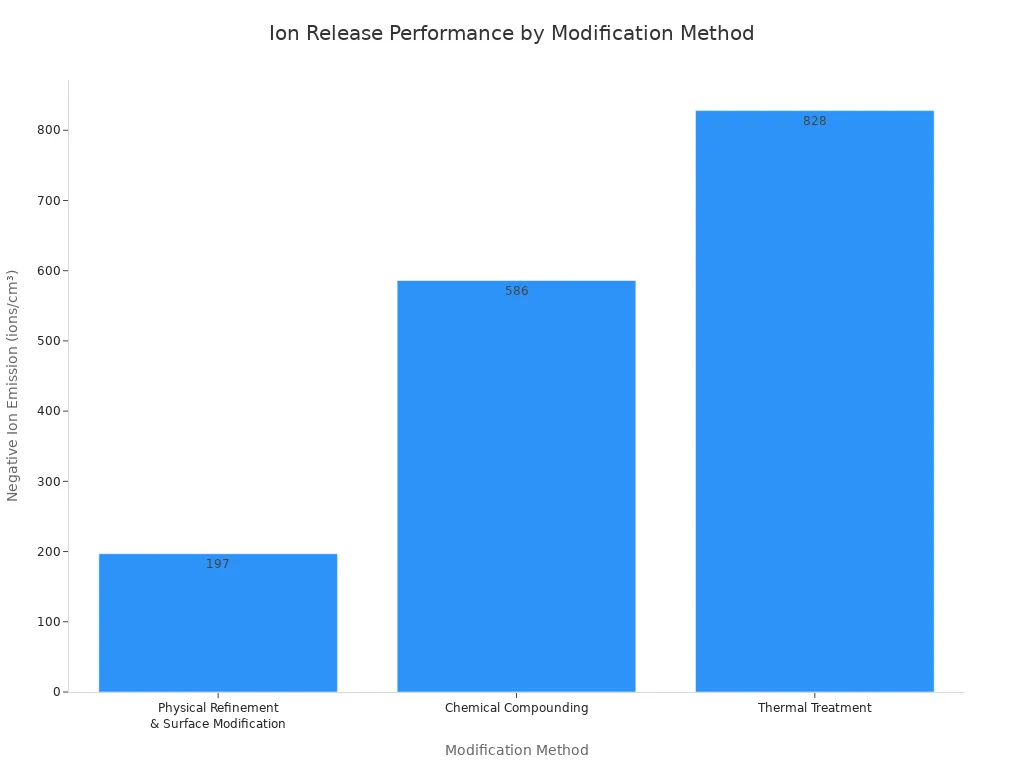
Scientists enhance the ion release capacity of materials like tourmaline through various modifications. Physical refinement, such as reducing particle size to 1200-mesh, increases the surface area. This larger surface area promotes more efficient ionization. This method significantly enhances the base negative-ion performance.
Further enhancements involve chemical compounding and thermal treatment. Adding 30 wt% Cerium Oxide (CeO_2) through chemical compounding boosts activation and emission properties. This raises negative ion emission from 197 ions/cm³ to 586 ions/cm³. High-temperature calcination at 900 °C for one hour also induces oxidation of Fe^{2+} to Fe^{3+}. This process causes lattice shrinkage and increases spontaneous polarity. Thermal treatment further boosts ion release capacity to 828 ions/cm³. These modifications ensure the paint releases a high concentration of negative ions. Negatively charged free hydroxyl groups in functional coatings also stimulate air and water molecules to produce negative oxygen ions.
Integrating Ionizers into Paint Formulations
Integrating ion-generating materials into paint formulations requires precise engineering. Manufacturers mill the modified inorganic powders to extremely fine sizes. This ensures even dispersion throughout the paint. Proper dispersion prevents settling and maintains consistent ion release across the painted surface.
The paint binder system must also be compatible with these active ingredients. The binder holds the pigments and ionizers together. It must not interfere with the ion-generating properties. Formulators carefully select binders that allow the active materials to interact with the air and moisture. This ensures continuous negative ion production.
Ensuring Stable and Long-Lasting Ion Emission
The goal of negative ion inorganic paint is to provide stable and long-lasting ion emission. The inherent properties of materials like tourmaline contribute to this stability. Their spontaneous electric fields do not degrade over time. This ensures a consistent release of negative ions throughout the paint’s lifespan.
Protective coatings and encapsulation techniques also help maintain ionizer integrity. These methods prevent degradation from environmental factors. They ensure the active materials remain effective for many years. This long-term stability makes negative ion paints a durable solution for air quality improvement.
Measuring Ion Output in Paints
Accurately measuring the ion output of paints is crucial for quality control. Specialized ion counters detect and quantify negative ions released from a painted surface. These devices measure the concentration of ions in ions per cubic centimeter (ions/cm³). This provides a clear metric for performance.
Testing occurs under controlled environmental conditions. This ensures consistent and comparable results. Regular testing helps manufacturers verify the effectiveness of their formulations. It also allows them to optimize the engineering process for maximum ion release.
Benefits and Applications of Negative Ion Paints
Air Purification and Pollutant Reduction
Negative ion inorganic paint offers significant advantages in air purification. Negative oxygen ions actively clean the air. They achieve this through a process involving charge transfer. These ions attach to airborne pollutants such as dust, pollen, and volatile organic compounds (VOCs). This attachment gives the pollutants a negative charge. Oppositely charged particles then attract each other, leading to particle aggregation. Larger, heavier clusters form. Gravity then pulls these aggregated particles out of the air. They settle onto surfaces, preventing inhalation. This functional mechanism effectively reduces airborne pollutants. It creates a cleaner and healthier breathing environment.
Health and Well-being Advantages
Exposure to negative ions provides several health and well-being benefits. A 2013 literature review found that several hours of negative ion exposure lowers depression scores for individuals with chronic depression and Seasonal Affective Disorder (SAD). Shorter 30-minute sessions also aid SAD symptoms. Clinical trials targeting SAD showed a positive therapeutic response in over 50% of participants. A 2015 study observed slight enhancements in cognitive performance after short-term exposure to elevated negative ion levels. A comprehensive 2018 review verified positive effects across several dimensions of human health and cognitive performance. Terman et al. (2018) noted high-density negative ion exposure significantly decreases subjective fatigue and increases alertness. Yao et al. (2020) found air ionization stabilizes circulatory functions, aids physical and mental recovery, and enhances blood oxygen saturation to improve overall lung health. Jiang et al. (2018) and Chronobiology International reported ionization filters respiratory micro-irritants to stabilize sleep phases. It also helps regulate circadian rhythms for faster sleep onset. Perez et al. (2013) and Frontiers in Psychology indicated ionic balance promotes an alert state of relaxation, decreases perceived mental stress, and enhances reaction time and memory retention. Bailey et al. (2018) and Psychiatry Research demonstrated high-density air ionization significantly elevates mood, similar to light therapy for SAD, and improves stress resilience. However, current scientific literature notes insufficient evidence regarding negative ions lowering blood pressure, improving general breathing, or regulating serotonin for anxiety.
Odor Neutralization and Antimicrobial Action
Negative ions also effectively neutralize unpleasant odors. They break down odor-causing molecules at a molecular level. This process eliminates the source of the smell rather than just masking it. Furthermore, negative ions exhibit antimicrobial properties. They can disrupt the cellular structure of bacteria and viruses. This action inhibits their growth and spread. This makes negative ion inorganic paint a valuable tool for maintaining hygienic indoor spaces.
Real-World Applications in Various Settings
Negative ion paints find diverse real-world applications. Homes benefit from improved indoor air quality, reducing allergens and pollutants. Offices can create more productive and comfortable work environments. Hospitals and clinics use these paints to enhance hygiene and reduce airborne pathogens. Schools and daycare centers can provide healthier spaces for children. Hotels and restaurants also utilize these paints to ensure fresh and inviting atmospheres for guests.
Environmental Impact and Sustainability
Negative ion inorganic paint contributes to environmental sustainability. Its air-purifying properties reduce the need for energy-intensive air filtration systems. The long-lasting nature of the ion emission means sustained benefits without frequent reapplication. Many formulations use natural minerals, making them more eco-friendly than traditional paints. This technology offers a sustainable solution for improving indoor air quality.
Negative ion inorganic paint generates beneficial ions through piezoelectric, pyroelectric, and semiconductor effects. These paints purify air, reduce pollutants, and enhance well-being. This innovative technology revolutionizes paint applications. It creates healthier living spaces, marking a significant step in smart, functional paints.
FAQ
How do negative ion paints purify the air?
Negative ions attach to airborne pollutants. This gives pollutants a negative charge. They then aggregate and settle out of the air. This process cleans the environment.
How long do negative ion paints release ions?
Materials like tourmaline have stable electric fields. They ensure consistent ion release. This emission lasts throughout the paint’s lifespan.
Are negative ion paints safe for indoor use?
Yes, negative ion paints are safe. They improve air quality and promote well-being. They do not produce harmful byproducts.
See Also
Discover The Advanced Science Behind Inorganic Anion Wall Paints Today
Create A Healthier Home Environment With Inorganic Anion Paint Solutions
Why Inorganic Anti-Alkali Primer Guarantees Extremely Durable Wall Finishes
Transform Your Eco-Friendly Living Space With Vibrant Inorganic Coatings
Comparing Inorganic And Organic Wall Coatings For Modern Home Design
