


Concrete cracks are a common issue across South Africa. You need effective repair solutions. This blog provides expert-reviewed recommendations for the best concrete crack fillers available in SA for 2026. You will gain clarity on top products and learn how to choose the right product. We focus on durability, ease of use, and suitability for local conditions, making this the ultimate guide for concrete crack sealer south africa.
Key Takeaways
Identify crack types and local climate conditions to choose the right concrete crack repair product.
Select flexible silicone sealants for moving joints and strong epoxy fillers for heavy load-bearing structural cracks.
Clean out debris and prep concrete surfaces thoroughly to ensure a long-lasting and effective repair.
Key Factors for Concrete Crack Sealer Selection:
Choosing the right concrete crack sealer requires careful consideration. You must understand several key factors to ensure a durable and effective repair. Do not just pick the first product you see.
Understanding Concrete Crack Types:
First, identify the type of crack you face. Different cracks demand different solutions. In South Africa, you commonly encounter specific categories of concrete cracks. These include hairline or surface cracks, which are minor and shallow, affecting only the concrete’s outer layer. You also find structural cracks; these are deeper, more critical fractures that impact the load-bearing capacity and stability of your structure. Finally, expansion joint cracks appear as separations or damage along designated movement and expansion joints. Knowing the crack type guides your product selection.
Environmental Factors in South Africa:
The unique South African environment significantly impacts concrete crack formation and repair material performance. For example, airborne chlorides in coastal zones infiltrate concrete, initiating rebar corrosion. This causes progressive structural failure. Inland regions experience thermal expansion cycles, generating cumulative stress on joints and causing separation. High UV radiation amplifies environmental stress, making exterior sealants brittle and reducing elasticity. Heavy seasonal rainfall facilitates water intrusion, overwhelming poor drainage. Intense summer heat and daily thermal swings accelerate structural cracking, demanding highly elastic outdoor repair fillers. Expansive clay soils shift foundations, creating new cracks. These factors mean your chosen concrete crack sealer south africa must withstand harsh local conditions.
Application Method and Skill Level:
Consider the application method and your skill level before purchasing a product. Some repairs are simple DIY tasks, while others require professional expertise. For instance, some products need no formal training (1/5 skill rating), while others demand a certified, specialist applicator (5/5 skill rating). You might need an electric drill with a mixing attachment for two-part products. For multi-coat systems, apply subsequent layers ‘wet-to-wet’ over the primer. Avoid water curing on cementitious sealing products; instead, protect the application with plastic sheeting. Understanding these requirements helps you avoid mistakes and potentially higher repair costs.
Top Concrete Crack Sealer Products for 2026:
You need the right product to tackle concrete cracks effectively. This section details the top concrete crack sealer products for 2026, offering innovative solutions for various repair needs in South Africa. You will find high-quality fillers designed for durability and ease of use.
Innovative Self-Healing Solutions:
Imagine a concrete repair that fixes itself. Innovative self-healing solutions are transforming how you approach concrete maintenance. The BANDě Cement Crack Sealer (Self-Healing Type) stands out as a groundbreaking product. This sealer uses a bionic self-healing method, creating an intelligent, bionic self-healing neural network system directly within your cement-based product. This means your concrete can autonomously repair micro-cracks, extending its lifespan and reducing future maintenance. This technology offers effective solutions for common problems like water leakage and structural degradation.
Consider the impressive performance of self-healing concrete solutions:
Metric Category | Performance Indicator / Standard | Detailed Benchmark |
|---|---|---|
Hydrostatic Permeability | Permeability Reduction | At least 80% decrease under 1.5 MPa pressure |
Hydrostatic Permeability | Standard Compliance & Penetration | DIN 1048 Part 5; Water depth < 30mm at 5 bar for 72 hrs |
Hydrostatic Permeability | Chloride Permeability | Rated “Low” or “Very Low” per ASTM C1202 |
Self-Healing Ability | Crack Sealing Width | Closes micro-cracks ranging from 0.5mm to 0.7mm |
Self-Healing Ability | Healing Time & Cycle | Autonomous closure in 7–28 days; supports repeated healing |
Structure & Depth | Crystallization Penetration | Extends to a minimum depth of 100mm from the surface |
Mechanical Impact | Strength & Shrinkage | 28-day compressive strength up by 5–15%; drying shrinkage ≤ 10% |
Environmental Compliance | Safety Standard | NSF/ANSI 61 approved for drinking water; 0 VOCs |
You can apply these advanced self-healing products in various critical areas:
Underground & Substructure: Use them in tunnels and building basements.
Water Retention & Storage: Protect dams, water tanks, and reservoirs.
Environmental Infrastructure: Secure wastewater treatment facilities.
Marine & Transport: Apply them to marine coastal structures and concrete highways.
High-Performance Structural Repair Options:
When you face structural damage, you need robust, high-performance products. These options provide the strength and durability necessary for critical repairs.
Sikadur®-52 ZA by Sika: This product offers exceptional performance for both new and refurbished concrete. It is a low-viscosity, high-strength epoxy resin that penetrates deep into cracks. You can use it for structural bonding and crack injection, ensuring a lasting repair.
PlastiSeal MMA Concrete Crack Sealer by Speccoats: For serious structural issues, this is a top choice. It is a methyl methacrylate (MMA) based sealer known for its rapid curing and superior bond strength. You can buy repair products like this in convenient 4 kg, 8 kg, and 18 kg kits, making it suitable for various project sizes.
Rust-Oleum EpoxyShield Concrete Patch: This widely recognized product provides a durable, long-lasting repair for spalled or cracked concrete. It is an epoxy-based solution that resists chemicals and abrasion, making it ideal for garage floors and industrial settings.
These products ensure your concrete structures remain sound and safe.
Flexible Sealants for Joints and Leaks:
For moving joints and persistent leaks, you need flexible sealants that accommodate movement without cracking. These products offer excellent elasticity and waterproofing.
Soudal SA Roof and Repair Sealant: This versatile sealant provides excellent flexibility and waterproofing. You can use it for sealing joints, repairing leaks in roofs, and general concrete applications. It adheres well to various surfaces, making it a reliable choice for many situations.
Sikaflex Self-Leveling Sealant: This popular product is perfect for horizontal joints where you need a self-leveling application. It flows into cracks and joints, creating a durable, flexible, and waterproof seal. It is one of the best concrete crack fillers for driveways and sidewalks.
Here is a comparison of various flexible sealants and their applications:
Sealant Name / Type | Primary Applications | Movement Capacity | Expected Durability / Lifespan |
|---|---|---|---|
Concrete Elite 100% RTV Silicone | Outdoor concrete expansion joints, foundations, driveways, and sidewalks | ±50% | 15–20 years |
SikaSwell | Water-exposed structures, hard-to-access construction joints, swimming pools, drinking water tanks | +30% (expansion) | 10–12 years |
RN 101-Ram-Nek (Preformed Plastic Gasket) | Precast concrete systems (storm sewer pipes, culverts, manhole risers, septic tanks, vaults) | ±15% | 8–10 years |
E5829 Flexible Epoxy-Urethane | High-traffic indoor concrete joint sealing tasks | ±25% | 7–10 years |
Sikaflex SL 2 | General concrete joint sealing with moderate UV exposure | ±25% | 5–7 years |
You can see the expected durability of these flexible sealants in the chart below:
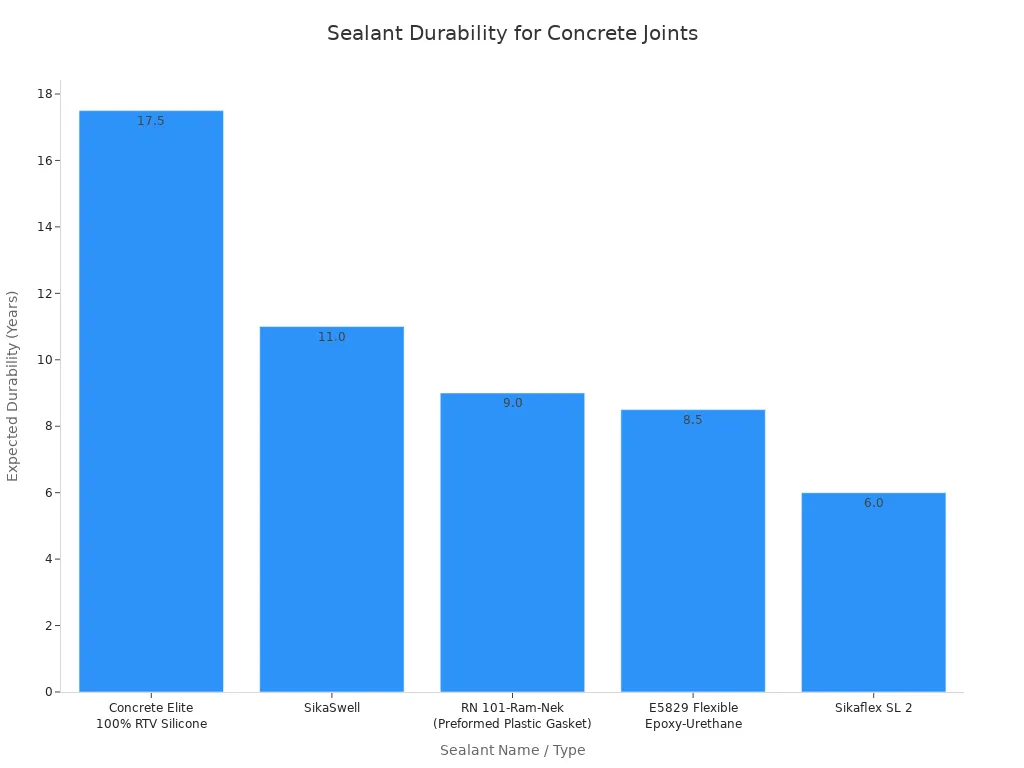
Flexible silicone sealants are ideal for large concrete slabs like building foundations and driveways. You also use them to fill repaired expansion joint cracks after clearing debris. These silicone flexible sealants offer a significant durability advantage, lasting up to 20 years. This is up to 10 times longer than polyurethane sealants, which typically require replacement after about 5 years.
Other notable flexible concrete floor repair products include:
Bostik Fireban® One: This fire-rated polyurethane sealant offers up to 4 hours of fire resistance. You design it for dynamic joints in precast panels, tilt-up walls, and exterior façades. It provides long-term resistance to aging and weather, making it perfect for demanding conditions in South Africa.
Sikaflex®-11 FC: This low-VOC MS polymer hybrid sealant and adhesive suits interior finishes and sensitive facilities. You can use it in schools and hospitals where air quality is a concern.
Choosing the right flexible sealant ensures your joints remain protected and watertight for years.
Best Fillers for Hairline Concrete Cracks:
Hairline cracks are common. They often appear on concrete surfaces. You need specific products to address these minor imperfections effectively. These fillers prevent further damage and improve your concrete’s appearance.
Products for Superficial Cracks:
You need specialized concrete crack fillers for superficial cracks. These products offer precise application and strong adhesion. They are the best for thin cracks and ensure a smooth finish.
Product Name | Base Material | Key Features & Suitability |
|---|---|---|
durarep FC | Cementitious | Thin coat, high strength, feather-edge finish for smoothing surface imperfections and blowholes |
epidermix® 505 | Epoxy | High strength, feather-edge application suitable for damp concrete substrates |
PLASTISEAL® MMA Concrete Crack Sealer is also specifically formulated as a dedicated sealing solution for repairing concrete cracks. It provides a robust repair for these minor surface issues.
Solutions for Aesthetic Repairs:
You want your concrete to look good after repairs. Aesthetic solutions focus on restoring the visual appeal of your surfaces. These methods are the best for thin cracks when you prioritize appearance. They also ensure the repair blends seamlessly.
Consider these recommended solutions for aesthetic and cosmetic repairs of concrete:
Concrete resurfacing: This restores the surface appearance. It covers superficial cracking effectively.
Hand-applied mortar techniques: You use these for detailed surface patching and cosmetic smoothing.
Carbon-fibre reinforcement: This fixes and prevents structural cracking. It preserves the original interior and exterior aesthetics without visual alteration. This is another excellent option, especially when you need the best for thin cracks that might have structural implications.
Leading Structural Concrete Crack Repair Solutions:
You need robust solutions for structural concrete cracks. These cracks compromise the integrity of your structures. You must choose specialized products to ensure lasting stability and safety.
Epoxy-Based Fillers for Load-Bearing Areas:
Epoxy-based fillers are your go-to choice for load-bearing concrete areas. They provide exceptional strength and adhesion. You can trust them to restore the structural integrity of your concrete. These are the best for foundations and other critical components.
Consider these high-performance epoxy concrete crack fillers:
Product Name | Primary Load-Bearing Application | Key Features & Properties |
|---|---|---|
Belzona 4111 (Magma-Quartz) | Floor, foundation, and void repairs | Excellent adhesion, heavy loading resistance, vibration resistance, and structural reinforcement |
Belzona 7111 | Pourable epoxy chocking under equipment footprints | Seamless load distribution, vibration minimization, and thermal cycling resistance |
Leading epoxy repair brands commonly utilized by construction specialists include:
Epoxyset
Epoxyshield
Mapei
Sika
Twistfix
These brands offer reliable products. They ensure your repairs are durable. You get the strength you need for critical areas.
Polyurethane for Dynamic Cracks:
Polyurethane sealants are essential for dynamic cracks. These cracks move due to thermal expansion or structural shifts. You need a flexible solution. Polyurethane provides excellent elasticity. It accommodates movement without re-cracking. This makes it ideal for effective concrete crack repair in areas with constant stress. You will find these concrete crack fillers perfect for joints and areas experiencing slight movement. They maintain a strong, flexible bond.
Best Fillers for Large Concrete Cracks and Gaps:

When you face significant damage, you need robust solutions. Large concrete cracks and gaps demand specialized concrete crack fillers. These products ensure structural integrity and prevent further deterioration. You can confidently tackle even the most challenging repairs.
Cementitious Repair Mortars:
For deep and wide damage, cementitious repair mortars are often the best for large cracks. These materials offer excellent compressive strength. They bond well with existing concrete. You can use them to rebuild missing sections or fill substantial voids. They provide a durable, long-lasting repair that integrates seamlessly with your structure. These mortars are ideal for restoring load-bearing capacity. They ensure your concrete remains strong and stable.
Flexible Sealants for Expansion Joints:
You need flexible sealants for expansion joints and dynamic gaps. These areas experience movement. You must choose products that can stretch and compress without failing. These are the best for large cracks that require flexibility. They prevent water intrusion and accommodate thermal expansion.
Consider these effective concrete floor repair products:
Sealant Type / Product | Recommended Method | Ideal Usage |
|---|---|---|
Jaycoflex M973 (2-Part Polysulphide Sealant) | Combine a foam-backing strip with self-leveling flexible polysulphide sealant to block water and absorb joint movement. | Expansion/movement joints up to 75mm in concrete floors, reservoirs, taxiways, basements, and civil engineering structures. |
You can also rely on PLASTISEAL® PUMMA Pourable Joint Sealant for superior performance:
Product Name | Key Characteristics | Recommended Applications |
|---|---|---|
PLASTISEAL® PUMMA Pourable Joint Sealant | Two-part, 100% solids, highly elastic resin; self-leveling; highly durable against chemicals, water, and impact. | Concrete floor expansion/contraction joints (interior/exterior), saw cut joints, and surrounding channels/drains. |
These sealants provide the flexibility and durability you need. They protect your concrete from environmental stressors.
DIY Concrete Crack Repair Products:
You can effectively tackle many concrete cracks yourself. DIY products offer convenience and cost-effectiveness. These solutions empower you to maintain your property without professional help.
Easy-to-Apply Cartridge Fillers:
For quick and simple fixes, easy-to-apply cartridge fillers are your best friend. You can use these products with a standard caulking gun. They make diy repairs straightforward.
Feature | Product Details |
|---|---|
Product Name | Soudal Repair Express Cement |
Material Type | Rigid cementitious filler |
Application Method | Applied via standard cartridge/caulking guns for simple DIY use |
Key Attributes | Fast, non-shrinking, high durability, paintable with all decorative paints |
Best Used For | Filling and repairing gaps, holes, and rigid surface damage in concrete, stone, and brick |
Consider Sikaflex-11FC+ for more dynamic cracks. This product offers excellent flexibility.
Feature | Product Details |
|---|---|
Product Name | Sikaflex-11FC+ |
Material Type | One-part elastic polyurethane joint sealant and adhesive |
Application Method | Dispensed easily using a standard caulking gun |
Key Attributes | Highly flexible, fast-curing, strong adhesion, suitable for indoor and outdoor use |
Best Used For | Larger, recurring, or active structural cracks and joints requiring movement accommodation |
These cartridge products provide reliable results for various crack types.
All-in-One Repair Kits:
For a comprehensive solution, all-in-one repair kits simplify your diy home project. These kits include everything you need. They help you save time and reduce overall costs.
Kit Type / Brand | Key Features & Components | Recommended Applications | Key Benefits |
|---|---|---|---|
Foundation Crack Repair Kit (e.g., RadonSeal) | Uses a multi-part system including 2-part epoxy for sealing, injection ports, and 2-part polyurethane foam with self-mixing nozzles. | Vertical poured-concrete basement walls and foundation cracks up to ½ inch thick. | Fast-setting (cures in ~4 hours), paintable, and blocks water, insects, and soil gases. |
Flexible Concrete Sealant (e.g., Sashco) | Highly elastic formula that stretches up to 3x crack width; packaged in standard 10-oz caulking cartridges for tool-free application. | Horizontal surfaces like driveways, sidewalks, patios, and floors (cracks up to 3 inches wide). | Weather-resistant against freeze-thaw cycles, easy squeeze application without trowels, and paintable. |
Premixed Patches & Waterproof Fillers | Ready-to-use formulas available in convenient premixed tubs, squeezable tubes, or bulk containers (up to 7 lbs). | Sidewalks, walkways, patios, driveways, and moisture-prone wet surfaces. | Highly user-friendly, provides waterproof finishes, and cleans up easily with soap and water after drying. |
You can choose a kit that matches your specific repair needs. These kits ensure you have the right materials for a lasting fix.
Choosing the Right Concrete Crack Filler:
You must select the correct concrete crack filler for a lasting repair. Different repair product types suit various crack scenarios. Understanding these differences helps you save on future costs and ensures durability. a.b.e. Construction Chemicals offers a range of concrete repair and protection products, including specialized crack injection systems, primers, and repair mortars.
Epoxy-Based Fillers: When to Use:
You should use epoxy-based fillers for structural cracks. These are the best for foundations and load-bearing areas. Epoxy provides exceptional strength and adhesion, effectively rebonding fractured concrete. You need these high-quality fillers when you require a permanent, rigid repair that restores the structural integrity of your concrete.
Polyurethane Sealants: Flexibility and Durability:
Polyurethane sealants offer excellent flexibility and durability. You choose them for dynamic cracks and expansion joints. These concrete crack fillers accommodate movement caused by temperature changes or structural shifts. They prevent water intrusion and maintain a strong, elastic bond, making them ideal for outdoor applications in South Africa.
Cementitious Repair Compounds: Strength and Aesthetics:
Cementitious repair compounds are perfect for restoring both the strength and appearance of your concrete. You use them for larger voids and spalled areas. These products offer significant advantages:
Superior Early Strength: Rapid strength gain accelerates structural recovery and project completion.
Aesthetic Flexibility: Provides a broad spectrum of decorative and aesthetic possibilities for concrete surfaces.
You can see their benefits in detail:
Advantage Category | Benefit / Feature | Details |
|---|---|---|
Strength | High Mechanical & Compression Strength | Provides high mechanical strength with exceptional early and final compressive performance (e.g., Sika MonoTop®-4200 Multi Flow). |
Strength | Structural Integrity & Durability | Restores original structural integrity, enhances durability, and extends overall service life. |
Aesthetic | Profile & Surface Restoration | Rebuilds original profiles, improves surface appearance, and delivers excellent surface finishing. |
Aesthetic | Defect Repair & Smoothing | Fills pores and repairs minor spalling/defects in thin layers (1–5mm) to produce smooth surfaces (e.g., Sika MonoTop®-3020). |
These concrete floor repair products are the best for foundations and other areas needing robust, aesthetic fixes.
Acrylic and Latex Fillers: Non-Structural Use:
You use acrylic and latex fillers for non-structural cracks. These products are ideal for hairline cracks and cosmetic repairs. They offer good adhesion and are easy to apply. You find them suitable for interior applications or areas where structural integrity is not a concern. These products are not designed for heavy loads or dynamic movement.
Expert Tips for Concrete Crack Repair:
You want your concrete crack repair to last. Following expert tips ensures a durable and effective fix. You can achieve a long-lasting solution with proper techniques.
Proper Crack Preparation Techniques:
Preparation is key for any successful repair. You must properly prepare the cracks before applying any filler.
Deep Cleaning & Substrate Prep: You need to thoroughly clean the interior crack paths. Remove all debris.
Precision Routing: Route along crack channels when specialized profiling is necessary.
For fine cracks, you must take specific steps:
High-Pressure Cleaning: Strip away the top surface concrete. Use a 200 bar high-pressure wash. This reveals hidden vertical and horizontal cracks.
Structural Inspection & Sounding: Conduct a structural assessment. Use a chip hammer to locate spalling, honeycombing, or corrosion in the steel rebar.
Square Cutting: For cracks exceeding 1 mm in width, cut edges roughly 120 mm on both sides. Broaden the base. Open around 20 mm behind the rebar. This forms a locking shelf for repair material.
Rebar Treatment: Apply a zinc-rich anti-corrosion primer to exposed steel reinforcing bars.
Substrate Saturation: Thoroughly soak the exposed concrete base with water. Do this prior to applying structural repair mortar.
V-Groove Chasing: For fine cracks under 1 mm wide, chase the paths. Use V-joint/V-groove cutting discs before sealing.
Application Best Practices for Longevity:
You need to apply fillers correctly for maximum repair life. These best practices ensure your repair endures.
Review manufacturer guidelines before application. This ensures proper installation techniques.
Evaluate potential joint movement. Choose a flexible filler that can absorb structural shifts.
Assess environmental exposure. Consider moisture, chemical contact, and extreme temperatures. Match filler resistance to these conditions.
Account for expected traffic weight. Select a durable material grade for heavy versus light loads.
Use the correct tools and application methods. Tailor them to the specific crack type. This maximizes repair life.
Common Mistakes to Avoid:
You can easily avoid common mistakes. Do not skip preparation steps. Applying filler to dirty or wet surfaces leads to failure. You must also avoid using the wrong type of filler for the crack. For example, do not use a rigid filler on a dynamic crack. Always allow proper curing time. Rushing the process compromises the repair’s strength.
You must choose the correct concrete crack fillers for lasting repairs and structural integrity. This guide showed you the best concrete crack fillers and their applications. Assess your specific needs carefully. Use these expert insights. Maintain your concrete surfaces. Ensure safety and durability for years to come.
FAQ
❓ How do I choose the best concrete crack filler for my project?
You must assess the crack type first. Consider its size, depth, and whether it is structural or non-structural. Match the filler to your specific needs for a lasting repair.
🛠️ Can I repair all concrete cracks myself?
You can tackle many cracks with DIY products. However, structural cracks or very large gaps often require professional expertise. Always prioritize safety and proper application.
💧 Is crack preparation really that important?
Yes, preparation is crucial. You must clean the crack thoroughly. Remove all debris. This ensures strong adhesion and a durable repair. Do not skip this vital step.
See Also
The Ultimate Comprehensive Guide To Repairing Cracks In Concrete
Essential Concrete Patching Materials Everyone Should Use This Year
How To Select The Ideal Epoxy Concrete Patch Compound
Complete Expert Advice For Applying Cement Crack Repair Sealers
