


Inorganic negative ions are negatively charged particles, naturally derived from minerals. We incorporate these negative ions into paint. This innovative paint actively improves indoor air quality. You will experience beneficial effects. How can this negative ion technology transform your indoor living spaces? This special paint acts as an Inorganic negative ion resting paint, continuously releasing negative air ions. These ions have effects.
Key Takeaways
Negative ion paint uses natural minerals to clean your air without electricity or filters.
These active ions destroy bacteria, remove dust, and neutralize harmful gases like formaldehyde.
You get continuous, long-lasting air purification simply by painting your indoor walls.
Science of Negative Air Ion Purification
Ion-Pollutant Interaction
Negative air ions play a crucial role in purifying your indoor environment. These ions actively seek out and neutralize various airborne pollutants. The primary mechanism involves the interaction of these negatively charged air ions with harmful particles. When water vapor is present in the air, it separates into positive hydrogen ions and negative oxygen ions. These negative ions then interact with single-cell contaminants, including bacteria and viruses. This interaction is highly effective. The ions disrupt the RNA and DNA of these microorganisms, stopping their reproduction. This deactivates the bacteria and viruses. After this process, the ions reform into H2O. Any droplets containing harmful pathogens are then trapped and fall out of the air. This effectively removes them from your breathing space.
Soft ionization further enhances these effects. This process produces charged ions that attach to airborne particles such as mold spores and bacteria. These particles then cluster together, becoming larger and heavier. This makes them much easier to remove through filtration or by simply settling out of the air. Soft ionization has also proven effective in reducing the viability of certain microorganisms. It disrupts their cellular structures, inhibiting their reproduction and survival. These negative ions provide a continuous cleaning action, improving the overall quality of your indoor air. The beneficial effects of these ions extend to various pollutants, making your home a healthier place.
Role of Inorganic Minerals
Inorganic minerals embedded within the paint act as catalysts. They facilitate the ionization of ambient water molecules upon exposure to the air. This is a fundamental part of the purification mechanism. The process begins when water molecules split into hydrogen ions (H+) and hydroxyl ions (OH-). Negatively charged free hydroxyl groups then stimulate surrounding air and water molecules. This action generates negative oxygen ions, which are the active “negative air ions” responsible for purification. These ions are continuously released, providing ongoing air treatment.
Minerals like tourmaline are commonly used for their ion-generating properties. Tourmaline, a ferroelectric mineral, exhibits pyroelectricity. This means it generates an electric potential when its temperature increases. To effectively release negative ions, this mineral requires physical external stimuli, such as pressure or friction. Its average particle size must also be controlled, typically between 1 millimeter and 5 micrometers. This size control is critical. It prevents degradation of the negative ion generation efficiency. Changes in the crystal structure and polarization phenomenon can reduce the negative effects. This mechanism shows that tourmaline generates ions through its pyroelectric (temperature-driven) and piezoelectric (pressure-driven) properties. These properties ionize surrounding water molecules in the air. The continuous release of these negative ions ensures a constant supply of purifying agents in your indoor environment. The effects are long-lasting and consistent.
Integrating Inorganic Negative Ions into Paint
Paint Manufacturing Process
You might wonder how these beneficial negative ions get into your paint. Manufacturers carefully select inorganic minerals known for their ability to generate negative ions. They finely mill these minerals into a powder. This process ensures the particles are small enough for uniform dispersion. Workers then thoroughly mix this fine powder into the paint formula during production. This step guarantees an even distribution of the ion-generating particles throughout the paint. When you apply the paint, every part of your wall will have these active components.
This meticulous integration ensures that once the paint dries, it becomes a functional surface. The embedded minerals are ready to begin their work. This careful manufacturing process is crucial. It ensures the paint consistently releases negative ions. You get the full effects of this innovative technology. The goal is to create a paint that actively improves your indoor air quality. The ionization process is key here.
Continuous Ion Release
Once applied and dry, the paint transforms into an inorganic negative ion resting paint. This means the embedded particles continuously release negative air ions into the surrounding air. These negative air ions are not a one-time release. They work constantly. Ambient conditions, such as humidity, often activate this release. The presence of water molecules in the air helps facilitate the ionization process. This continuous generation of negative air ions provides ongoing purification.
You benefit from a steady supply of these beneficial ions. The paint acts as a passive air purifier. It works without needing electricity or filters. This constant release ensures that the air in your home always receives a fresh supply of negative ions. These ions then interact with pollutants, neutralizing them. The long-term effects of this continuous ion release contribute to a healthier and more pleasant indoor environment. This innovative inorganic negative ion resting paint offers a sustained solution for better air. You will notice the positive effects. The negatively charged particles do their work.
Health Benefits of Negative Ion Paint
You will find that the high capacity for generating negative ions helps neutralize and remove pernicious indoor pollutants. This significantly improves your indoor air quality. These negative air ions actively target various airborne contaminants. You experience a cleaner, healthier environment.
Air Quality & Odor Neutralization
Negative air ions play a vital role in enhancing your air quality. They effectively reduce airborne allergens, dust, and particulate matter (PM2.5). These negative ions attach to airborne particles, giving them a negative charge. These charged particles then repel each other and are attracted to grounded surfaces. They settle out of your breathing zone. This mechanism removes allergens from the air without needing filters or chemicals.
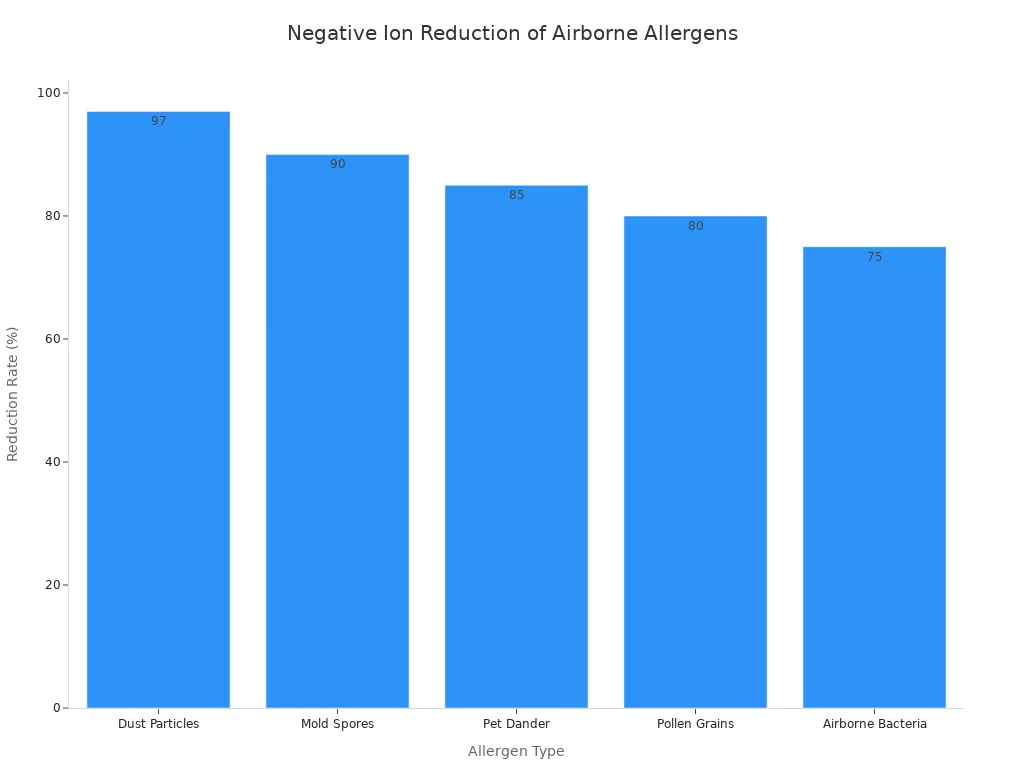
Consider the significant reduction rates for common allergens:
Allergen Type | Reduction Rate |
|---|---|
Dust Particles (incl. dust mite debris) | Up to 97% |
Mold Spores | Up to 90% |
Pet Dander | ~85% |
Pollen Grains | ~80% |
Airborne Bacteria | ~75% |
Figures based on controlled research studies.
You can see the effectiveness of negative ions in reducing various airborne allergens in the chart below.
A peer-reviewed study in PMC demonstrated that negative ions directly kill dust mites. This includes Dermatophagoides pteronyssinus and D. farinae. Mortality increases proportionally to exposure time. The study concludes that ionizers can reduce natural mite populations on exposed surfaces. They also contribute to reducing allergen exposure by both killing mites and denaturing their allergens. This shows a direct health effect.
Furthermore, negative ions help break down and neutralize unpleasant odors. They interact with odor molecules, altering their chemical structure. This process eliminates the smell rather than just masking it. You will notice a fresher scent in your home. This continuous release of negative ions provides ongoing purification. The effects are noticeable. This constant negative air ionization therapy contributes to your overall well-being.
Reducing VOCs & Formaldehyde
Negative ion paint also helps mitigate harmful volatile organic compounds (VOCs). These include formaldehyde, ammonia, and benzene. These compounds are common in indoor air. They originate from building materials, furniture, and cleaning products. The negative ions interact with these harmful molecules. They initiate a chemical reaction that breaks them down into less harmful substances. This mechanism effectively reduces their concentration in your indoor environment.
For example, formaldehyde is a known irritant and carcinogen. Negative ions can attach to formaldehyde molecules. This process neutralizes them. You experience fewer respiratory issues and other health concerns associated with VOC exposure. This continuous ion release provides a passive yet powerful therapy. It works to cleanse your air. The beneficial effects extend to reducing other pollutants. This makes your living space safer. This innovative paint offers a consistent health effect. It provides a form of negative ion therapy. You will appreciate the improved air quality. The negative ions work tirelessly.
Inorganic negative ion resting paint actively purifies indoor air. It neutralizes various indoor pollutants. You experience improved air quality, odor neutralization, and reduced VOCs, formaldehyde, and PM2.5. This paint offers a continuous, passive, and innovative solution. It creates healthier, more pleasant indoor environments. These negative air ions provide lasting effects for your well-being. These ions are the future.
FAQ
How long do the negative ions last in the paint?
The inorganic negative ion resting paint continuously releases negative air ions. These ions provide long-lasting effects. You get ongoing air purification for many years. The beneficial effects are constant. You will notice these positive effects.
Do I need to do anything to activate the negative ions?
No, you do not. The embedded minerals in the paint continuously release negative air ions. Ambient conditions like humidity activate the ionization process. You experience the beneficial effects passively. These negative ions work without effort. Their effects are continuous.
Are there any side effects from negative ion paint?
No, there are no known harmful effects. Negative air ions are natural. They offer a safe and continuous indoor air therapy. You will only experience positive effects. These ions improve your indoor environment. The negative ion effects are beneficial. You will appreciate these effects.
See Also
Discovering The Modern Technology Behind Inorganic Anion Wall Paints Today
Create A Cleaner Living Space With Inorganic Anion Wall Paint
Why Your Home Needs An Effective Inorganic Anti-Alkali Primer Base
Understanding How Lithium Densifier Technology Strengthens Your Concrete Surfaces Completely
Applying Inorganic Seven-Color Coating For An Eco-Friendly Interior Renovation
