

You have invested in a new concrete floor. The right concrete protection coating prevents stains, abrasion, and chemical damage. The wrong concrete protection coating leads to peeling, blistering, and costly rework. The US concrete sealers market reached $294.5 million in 2024, proving this decision’s importance. Your project’s demands dictate the ideal concrete coating. Understanding these factors transforms an overwhelming choice into confidence.
Key Takeaways
Match your coating to the environment. Use UV-stable polyaspartic for outdoors. Use moisture-tolerant primers for high moisture slabs.
Choose coating based on durability needs. Polyaspartic has 6x the abrasion resistance of epoxy. It lasts over 15 years in high-traffic areas.
Balance cure time and budget. Polyaspartic allows foot traffic in 4-6 hours. Faster cure reduces downtime, justifying higher material cost.
Main Types of Concrete Coatings
The concrete protection industry organizes products into four polymer families: epoxies, urethanes, acrylics, and polyureas. Each family delivers distinct performance characteristics. Your project’s demands determine which family fits best. Understanding these categories helps you navigate the many types of concrete coatings available today.
Epoxy Coatings
Epoxy coatings earn their reputation for exceptional hardness, durability, and impact resistance. You will find them serving as base coats, moisture barriers, or resurfacing layers on industrial floors and garage surfaces. The application process requires careful surface preparation and mixing only what you can apply during the open time. You should apply a minimum of two coats for an effective moisture barrier.
However, epoxy coatings have a critical weakness. UV rays penetrate the coating and break down polymer chains through photodegradation. The surface becomes brittle, yellows with an amber tint, and eventually develops a powdery white residue called chalking. You should use epoxy only indoors or in fully covered areas. For outdoor exposure, you need a UV-stable topcoat. Standard epoxy service life reaches 3–5 years under typical conditions.
Polyurethane and Polyaspartic Coatings
Polyurethane coatings excel as topcoats where surface wear and impact resistance matter most. You will choose them for their toughness and flexibility. Polyaspartic coatings, a subset of polyureas, cure faster and last longer. You can walk on a polyaspartic floor within 4–6 hours, while epoxy requires 24+ hours. Full vehicle use comes after 24 hours for polyaspartic versus 72+ hours for epoxy.
“Polyaspartics have almost three times the abrasion resistance of epoxies, and are more flexible and UV stable.”
Polyaspartic coatings deliver professional-grade service life of 15+ years. They maintain color and integrity under sunlight, making them ideal for outdoor applications. Both polyurethane coatings and polyaspartics work excellently as topcoats over epoxy bases.
Beyond these film-forming options, you should consider the types of concrete sealers. Acrylic coatings often appear as water-based emulsions used during curing or as low-cost sealers. Acrylic sealers provide temporary protection but need touch-ups sooner than other options. Penetrating sealers, including silanes and siloxanes, repel water and chlorides without forming a surface film. These penetrating sealers prove critical for exterior decks and parking structures. Film-forming sealers include both polyurethane sealers and epoxy sealers for different protection levels. Understanding all types of concrete sealers ensures you select the right protection for your specific conditions.
Key Factors for Choosing a Concrete Protection Coating
The right concrete protection coating lives at the intersection of three project questions. What environment will it face? What performance must it deliver? What application and budget constraints apply? Answering these questions systematically eliminates unsuitable options.
Environmental Exposure
What environment must your concrete protection coating survive? Three factors rule out coating families immediately. First, UV stability. Epoxy coatings amber and chalk under direct sunlight. You must avoid them for exteriors unless you use a UV-stable topcoat. Polyurethane coatings and polyaspartic coatings resist UV damage effectively. Second, chemical resistance. You need a 100% solids epoxy or novolac epoxy for industrial settings exposed to acids, solvents, or deicing salts. These formulations resist harsh chemical attack. Third, moisture vapor transmission (MVT). You must test your slab before selecting any coating. The ASTM F1869 calcium chloride test measures MVT in pounds per 24 hours per 1,000 square feet. The ASTM F2170 in-situ RH probe test is more comprehensive. Conventional floor primers work only for MVT rates below 3 lbs. Specialty primers handle up to 20 lbs. The table below matches coating systems to MVT levels.
MVT Level (lbs/24 hrs/1,000 sq ft) | Recommended Flooring System | Risk Level |
|---|---|---|
Below 3 lbs | Standard epoxy | Low Risk |
3 – 5 lbs | Moisture-tolerant epoxy | Moderate Risk |
5 – 10 lbs | Breathable epoxy + moisture primer | High Risk |
Above 10 lbs | 100% solids moisture vapor barrier | Critical Risk |
Performance and Durability Needs
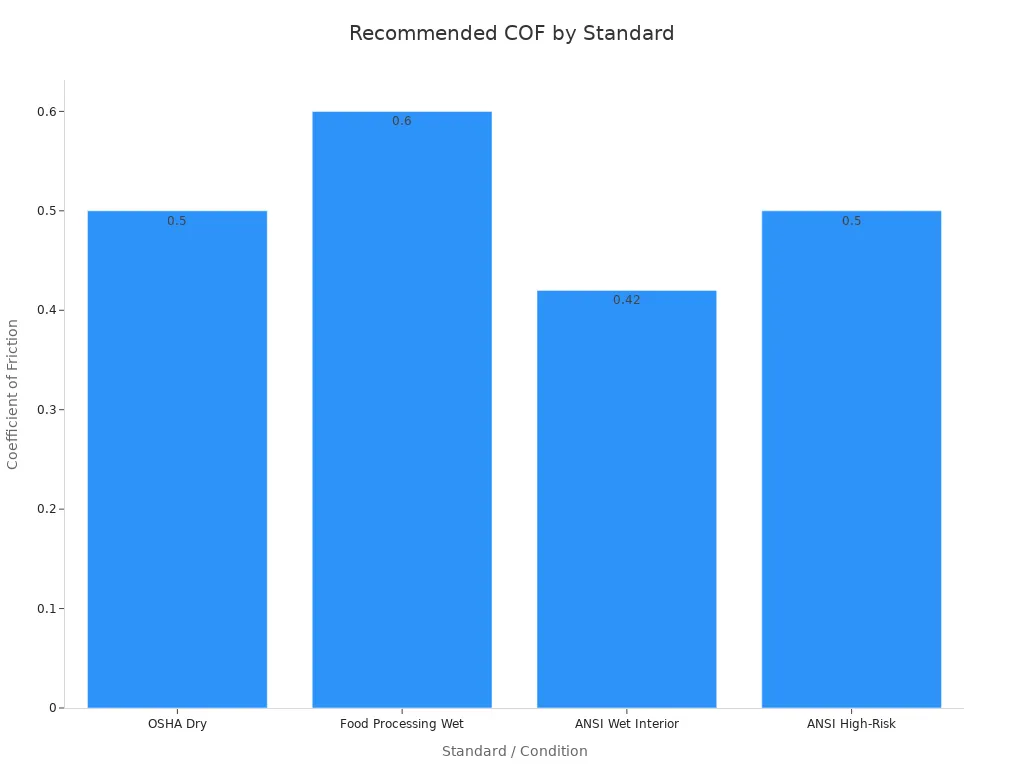
What performance demands will your concrete coating face? The answer determines thickness, hardness, and slip resistance. For high-traffic industrial floors with forklift traffic, look at abrasion resistance metrics. Commercial-grade epoxy shows 20–45 mg weight loss in the Taber Abrasion Test. High-performance polyurethane coatings show only 4–8 mg. Polyaspartic coatings are 6x stronger than epoxy. For slip resistance, especially in wet or food-processing areas, you need a measurable standard. The Dynamic Coefficient of Friction (DCOF) is measured using a BOT-3000E device per ANSI A326.3-2021. The minimum wet DCOF is 0.42 for interior floors. For higher-risk environments, a DCOF above 0.50 is required. The chart below illustrates these values.
Expected lifespan also matters. Epoxy coatings last 10–20 years. Polyurethane coatings last 12–20 years. Polyaspartic coatings last 10–15 years. For a residential garage, standard epoxy provides adequate long-term durability. For a warehouse with heavy forklift traffic, you need a high-build polyurethane or polyaspartic system.
Application and Budget Constraints
How do application constraints and budget affect the choice? Surface preparation is non-negotiable. Each coating requires a specific Concrete Surface Profile (CSP). Thin-film epoxies need CSP 1–3. High-build epoxies and urethanes need CSP 3–5. You must match the preparation method to the coating. Ambient conditions also matter. Surface temperature must be checked in multiple locations. Humidity must stay between 30% and 80% RH. Air circulation clears solvent vapors, but you must not direct airflow across the coating surface. The dew point rule is critical: if surface temperature is within 5°F of the dew point, condensation occurs, causing adhesion failure.
Cure time dictates the coating choice in facilities needing rapid return to service. Standard epoxy requires 12–24 hours for foot traffic and 72 hours for heavy equipment. Polyaspartic coatings allow foot traffic in 2–4 hours and full return in 24 hours. As Dr. Robert Vance explains, “The adoption of polyaspartic aliphatic polyureas has reduced commercial facility downtime by an average of 60% compared to traditional epoxy systems.” Cost per square foot varies. Epoxy costs $3–$12. Polyaspartic costs $5–$18. Acrylic costs $1–$3. Faster cure times often justify a higher material cost due to reduced downtime. Use this decision framework to narrow your options: name the governing requirement per zone, check feasibility (downtime, slab condition, moisture), set your budget envelope, and use a selection matrix to produce a short list of candidate systems.
Choosing the right concrete protection coating requires balancing performance, environment, and practicality. Use the factors above as your checklist. Compare them against your project specifications. Consult a coatings professional before committing. Then apply a small test patch in a non-critical area. This validation prevents costly failures. Your informed decision about concrete coatings leads directly to a durable, long-lasting concrete coating investment.
FAQ
How do you clean and maintain a coated concrete floor?
You clean coated floors with a mild detergent and water. Avoid harsh chemicals or abrasive pads. They can dull the surface. Regular sweeping prevents dirt from grinding into the coating.
Can you apply a new coating over an existing one?
You can, but only after proper preparation. The old coating must be clean, sound, and properly profiled. Delaminating or peeling sections require complete removal first. Test adhesion before proceeding.
How do you know when your concrete coating needs replacement?
You look for visible wear signs. Chalking, peeling, or loss of gloss indicate failure. If water penetrates the surface or stains appear, the coating has lost its protective function. Time to recoat.
See Also
The Ultimate Handbook For Selecting The Finest Concrete Sealer
Discovering The Perfect Concrete Sealer To Suit Your Requirements
BANDě Concrete Sealer: The Complete Guide To Picking The Top For 2025
Selecting The Finest: Five Leading Concrete Floor Hardeners For Commercial Use
