


Ever wondered how some concrete floors achieve that incredibly hard, durable, and polished concrete look? A crystal floor liquid densifier is the secret. This chemical solution penetrates your concrete slab. It hardens the floor after curing or placement. This enhances the floor’s durability and creates beautiful polished floor surfaces.
Key Takeaways
Liquid densifiers penetrate concrete slabs to form hard crystals that permanently stop surface dusting.
Chemical hardening increases concrete strength and abrasion resistance by up to five hundred percent.
Densified floors resist heavy traffic and spills while creating a beautiful reflective polish for decades.
Understanding Crystal Floor Liquid Densifiers
What is a Crystal Floor Densifier?
A crystal floor liquid densifier is a specialized liquid chemical solution. You apply it to a concrete slab. This concrete densifier penetrates the surface. It chemically hardens the floor. Think of it as a super-strengthener for your concrete floor.
The Chemical Hardening Process
When you apply a densifier, it does not just sit on the surface. It reacts with specific compounds inside the concrete. Concrete contains free lime, also known as calcium hydroxide. This is a byproduct of the cement hydration process.
The fundamental reaction occurs when silicate and silica compounds interact with free calcium ions to synthesize solid calcium silicate. This compound drives the densification effect while generating minor chemical byproducts.
Liquid densifiers penetrate the concrete surface to react with existing calcium hydroxide. This produces additional calcium silicate hydrate (CSH) gel. CSH is the fundamental compound responsible for concrete’s strength. Generating new CSH within the capillary pores consolidates loose particles. It forms a tightly bound, crystalline matrix. This process is known as concrete densification.
The chemical reaction starts quickly.
Concrete exhibits a 32% increase in
hardnesswithin the first 30 minutes post-application.The primary chemical reaction requires a dwell time of approximately 30 minutes before you flush away excess product.
Most potassium and lithium-based densifiers establish a set within 4 to 8 hours. The underlying chemical reaction can continue to progress for up to 72 hours. This ongoing reaction ensures deep and thorough hardening.
Crystalline Bonds and Pore Filling
The reaction creates a new crystalline structure. This structure is called calcium silicate hydrate (CSH) crystals. These crystals fill the tiny, open pores within the concrete slab.
Silicate-based
densifierliquid is applied to theslab‘s surface. It penetrates into theslab. It remains fluid for at least 30 minutes.The
densifierreacts with free Calcium Hydroxide. This is a soft byproduct of initial cement hydration.This reaction generates CSH crystals and paste inside micro-fractures, pinholes, and microscopic pores.
The newly formed CSH integrates and bonds with existing CSH. This creates a hard, dense, and non-dusting concrete surface.
Silicate ions from densifier chemical compounds interact with calcium hydroxide present in the concrete matrix. This chemical reaction leads to the precipitation of calcium silicate hydrate (CSH) crystals directly within the concrete’s pores. It fills voids and the capillary network. This fills empty spaces. It increases structural density and reduces porosity. This process significantly reduces the porosity of the floor. It also reduces water permeability. Yet, it still allows the floor to remain vapor permeable. This means moisture can escape from below. This is crucial for the long-term health of your polished concrete floor.
Benefits of Concrete Densifier Application
Increased Strength and Durability
Applying a densifier significantly improves your concrete floor’s wear resistance. It fuses sand particles directly into the concrete matrix. This process creates a much harder and more robust surface. You will notice a substantial increase in the floor’s ability to withstand daily wear and tear. This makes your floor an impact resistant surface.
Consider the impressive gains in abrasion resistance you can achieve:
Treatment Type | Abrasion Resistance Increase (15 Min) | Abrasion Resistance Increase (30 Min) |
|---|---|---|
Standard Densifier (Duro-Nox) | ~500% | 145% |
Low-Sodium Densifier (Duro-Nox LS) | ~300% | 145% |
Lithium-Silicate Densifier (Duro-Nox LSC) | 200% | 90% |
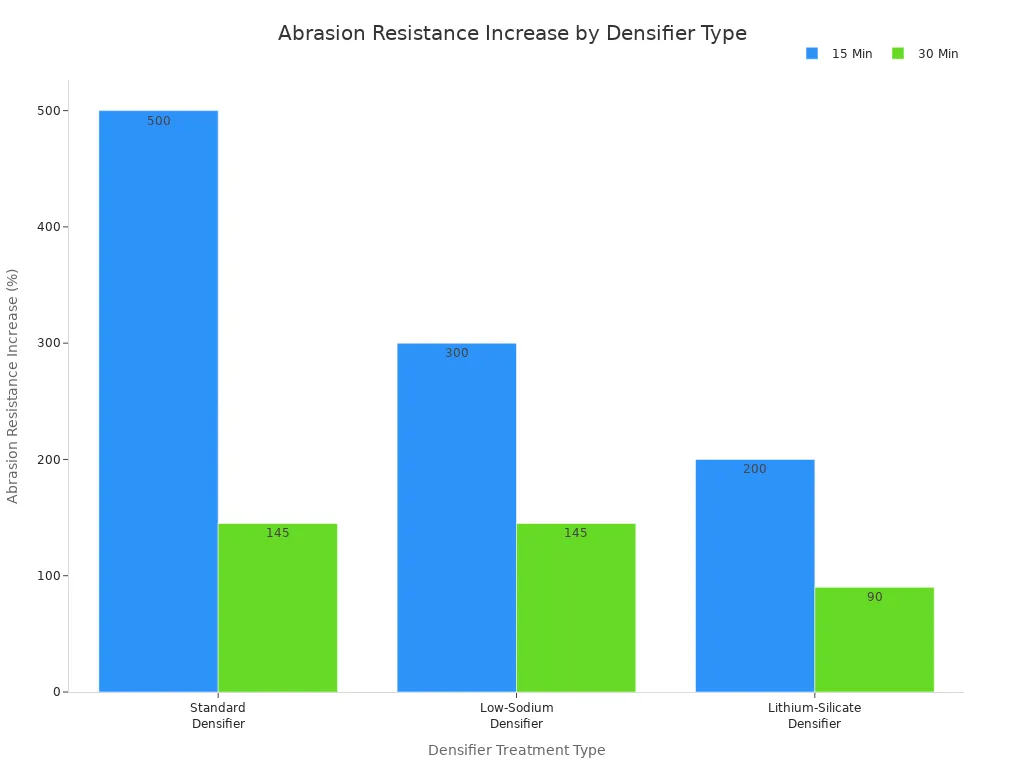
This chart clearly shows how a densifier dramatically boosts your floor’s hardness and durability. You gain a floor that stands up to heavy use.
Reduced Dusting and Improved Cleanliness
Untreated concrete naturally releases fine dust particles over time. This continuous dusting creates a messy environment. It also poses potential health concerns. A densifier prevents this natural dusting. It creates a dustproof concrete surface. This significantly contributes to a cleaner and healthier space.
Densification helps create a cleaner environment. It utilizes biomass and agro-residues for sustainable energy production. Converting these raw materials into densified energy sources prevents harmful open-field burning and unmanaged dumping. This mitigates key environmental hazards and reduces emissions. You get a cleaner floor and contribute to a cleaner planet.
Enhanced Appearance and Chemical Resistance
A densified floor offers more than just strength. It also provides an enhanced aesthetic appeal. The densification process prepares the concrete for a superior polish. This results in a beautiful, reflective polished concrete surface. This surface not only looks good but also resists chemical attacks. You gain a floor that maintains its pristine look even when exposed to spills. This improved chemical resistance contributes significantly to the floor’s longevity. It also preserves its aesthetic appeal over many years.
Extended Floor Lifespan
Investing in concrete densification extends the life of your floor. The increased hardness, reduced dusting, and improved chemical resistance all work together. They protect your floor from premature wear and degradation. This means you replace or repair your floor less often. You save money and resources in the long run.
Many applications benefit greatly from a crystal floor liquid densifier. These include:
Industrial & Logistics Facilities: Warehouses and manufacturing sites require high resistance to heavy mechanical load, abrasion, and harsh wear.
High-Traffic Transportation & Public Hubs: Airport terminals endure constant foot traffic and rolling loads.
Sanitary & Regulated Settings: Food processing plants and healthcare centers benefit from dust-proofing and clean surface properties.
Commercial Retail & Display: Retail stores withstand non-stop public foot traffic while maintaining surface integrity.
Residential Spaces: Polished concrete garage floors require a durable, industrial-grade aesthetic.
A concrete densifier is an essential treatment. It ensures your floor performs optimally and lasts for decades.
A crystal floor liquid densifier chemically hardens your concrete slab. This transforms your floor for superior performance. You gain increased durability, reduced maintenance, and enhanced aesthetics. Your floor also gets improved chemical resistance. Consider a densifier for your next concrete floor project. It is an essential investment.
FAQ
How long does a densifier last?
A densifier provides permanent hardening. It becomes an integral part of your concrete. You will enjoy its benefits for the life of your floor.
Can I apply a densifier myself?
Yes, you can apply many densifiers yourself. Follow the manufacturer’s instructions carefully. Proper application ensures the best results for your floor.
Is a densifier suitable for all concrete types?
Most densifiers work well on standard concrete. Always check product specifications. Some specialized concrete types might require different treatments.
See Also
Understanding Floor Hardeners And Their Essential Working Mechanisms Explained
A Complete Guide To Concrete Hardeners And How They Function
Everything You Need To Know About BANDe Concrete Floor Hardeners
How Concrete Densifiers Actually Work To Protect Your Heavy Floors
Selecting The Ultimate Concrete Densifier For Busy Industrial Warehouse Flooring
