

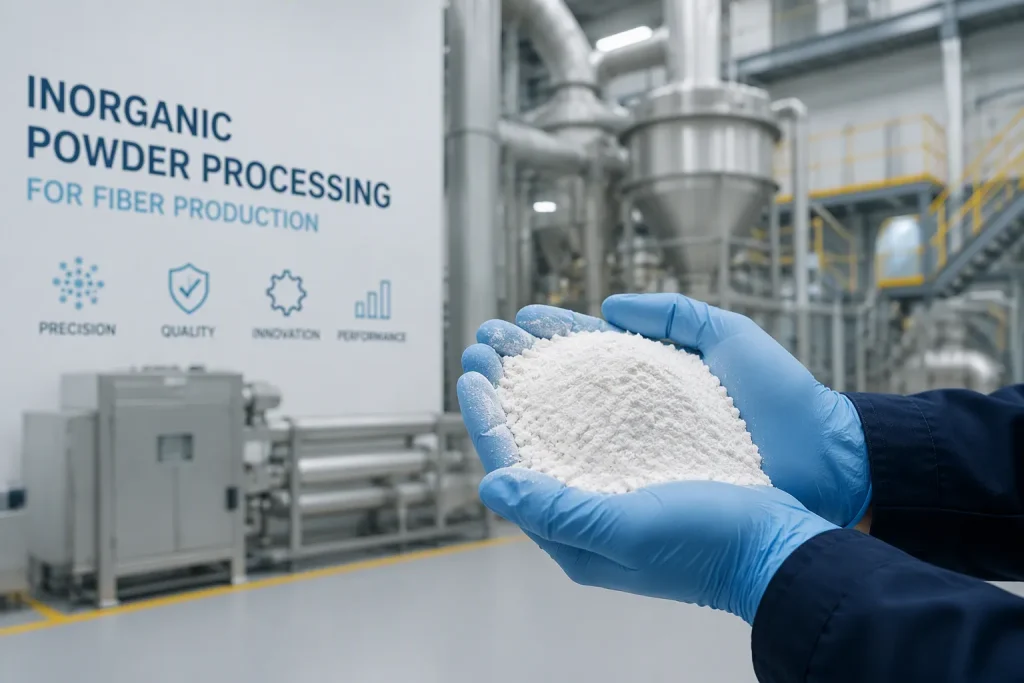
What if a supplier of inorganic powder for fiber could guarantee both quality and cost efficiency? BANDě’s factory delivers this through advanced manufacturing and scalable operations. Distributors add 30–50% markups, while a case study of aluminium hydroxide reported a 35% cost reduction with factory-direct supply. BANDě enables applications from fiber-metal powder paper to sintered filters, ensuring consistent quality.
Key Takeaways
BANDě’s factory ensures consistent quality with rigorous testing, including XRD analysis, to meet exact fiber specifications.
Custom formulations and technical support tailor powders to specific fiber applications, enhancing performance and functionality.
Factory-direct supply cuts costs by 30-50%, with scalable production and efficient processes for competitive pricing.
Inorganic Powder for Fiber: Quality and Consistency
Advanced Manufacturing with Rigorous Testing
BANDě’s factory employs advanced manufacturing protocols that place quality control at the center of every production run. The company recognizes that inorganic powder for fiber must meet exacting specifications, since even minor variations in particle size or phase composition can compromise downstream performance.
X-ray diffraction (XRD) analysis serves as a cornerstone of BANDě’s quality assurance program. This technique verifies phase purity by confirming the successful formation of the target phase while detecting any unreacted precursors or undesired by-products. Secondary phases directly impact physical, chemical, and functional properties, including electronic, catalytic, or structural performance. Quantitative methods such as Rietveld refinement provide precise phase fractions, ensuring each batch meets required specifications.
Rigorous testing protocols reduce defects across fiber production lines:
Test results guide the selection of dyes and finishes, ensuring compatibility with fiber types and preventing chemical reaction defects.
Results influence production techniques, tailoring handling and processing methods to maintain fiber properties and reduce damage.
Testing aids troubleshooting: when a product fails standards, manufacturers use test results to identify root causes and take corrective actions.
Comparing test results against known standards ensures raw material quality; discrepancies trigger investigation before defects propagate.
The impact of this rigorous approach appears clearly in porous ceramic applications. Rare-earth aluminate porous ceramics, such as LaAlO₃, achieve thermal conductivity as low as 0.4 W/(m·K) at temperatures of 1000–1500°C. This value significantly outperforms conventional alumina-based insulators. Sintering parameters directly influence performance:
Sintering Temperature (°C) | Porosity (%) | Thermal Conductivity (W/(m·K)) |
|---|---|---|
1050 | 71.4 | |
1080 | 83.7 | 0.150 |
Higher porosity produces lower thermal conductivity, demonstrating how controlled manufacturing parameters deliver predictable material behavior. This level of control matters for glass fiber, carbon fiber, and ceramic fiber production alike.
Custom Solutions and Technical Support
BANDě’s factory extends beyond standard products to deliver custom formulations tailored to specific fiber applications. The technical team works directly with manufacturers to match powder characteristics with production requirements.
Product | Carrier | Fiber-Specific Application |
|---|---|---|
Ethylene Glycol | Inorganic UV blocker for PET fiber synthesis; supplied in fiber-grade EG for direct addition during polymerization. | |
NYACOL® TiCoat | Water | Photocatalytic TiO₂ dispersion for textiles, providing self-cleaning functionality under fluorescent, LED, or sunlight. |
NYACOL® CeO₂(AC) | Water | Cerium oxide dispersion as a transparent UV absorber in fiber formulations. |
NYACOL® DP6255 | Water | Pure cerium oxide with high visible transparency, suitable for UV absorption in alkaline systems. |
These examples illustrate how inorganic powder for fiber can be engineered for specific carriers and functional requirements. The factory’s technical support team assists with formulation adjustments, processing parameters, and troubleshooting. When a product fails standards, the team analyzes test results to identify root causes, whether poor fiber quality or improper handling, then implements corrective actions.
This combination of rigorous testing and custom development ensures that inorganic powder for fiber consistently meets the demands of modern fiber manufacturing. BANDě’s factory delivers uniform density, predictable thermal behavior, and reliable chemical compatibility across every batch.
Scale, Cost, and Reliable Supply
High Capacity for Large Orders
BANDě’s factory supports glass, carbon, ceramic, and metallic fiber production with consistent supply for large-volume contracts. Glass fiber manufacturing relies on precise powder formulations for melt processing. Carbon fiber production requires inorganic additives for surface treatment. Ceramic fiber uses powders for thermal stability enhancement. Metallic fiber demands uniform particle distribution for consistent alloy properties. The facility accommodates each fiber type’s specific powder requirements without compromising delivery timelines.
Inventory management systems ensure reliable fulfillment. Barcode scanning technology achieves 99.9999+ percent accuracy, with one error per 70 million scans. This precision far exceeds manual keying methods at approximately two percent error. Cycle counting follows a structured approach. The team counts A items monthly, C items every six months. Each count compares physical inventory against records, and the team investigates discrepancies immediately.
Inventory strategies include Just-in-Time (JIT) delivery, which aligns material arrivals with production schedules. Material Requirements Planning (MRP) uses demand forecasts to ensure material availability. Economic Order Quantity (EOQ) models balance ordering frequency against holding costs. Safety stock buffers protect against demand variability and supply disruptions.
Automation strengthens capacity. Automated weighing and filling systems allow one operator to handle tasks previously requiring three, achieving a two-thirds labor cost reduction. Vacuum conveying eliminates manual tasks like climbing ladders, dumping bags, and using forklifts. These systems operate continuously without fatigue, enabling higher throughput. A spice manufacturer case study reported 50 percent labor reduction and 300 percent production capacity increase with similar automation.
Logistical challenges accompany bulk powder shipping. Flowability issues arise during transfer from hoppers to freight cars. Fines become windblown during shipping, causing material loss. Moisture absorption degrades product quality, especially for hygroscopic materials. Caking creates undesirable clumping. Segregation causes homogeneous mixtures to de-mix during agitation.
International demand stretches shipping times and exposes powder to varied climates. Air freight stabilizes delivery but at higher cost; container shipping risks moisture exposure. We developed tailored liners, custom-sealed drumming, and accelerated customs clearance procedures to help powder reach users in prime condition.
Efficient Processes for Competitive Pricing
Efficient manufacturing reduces costs directly. Powder bindings for fiber composites demonstrate this advantage clearly. Powder binder addition reduces resin matrix processing time from 30 minutes to 17 minutes at 180 degrees Celsius, directly lowering manufacturing cycle time and cost. Binders enable automation of preform assembly, reducing labor costs because hand laminating requires time-intensive skilled labor. Cost modeling shows a 52 percent reduction for regional aircraft aileron skins and 60 percent reduction for tailplane skins compared to conventional prepreg tape laying. Powder binder applied to filler tapes allows them to stick together under pressure and heat, significantly reducing labor costs and eliminating human factor influence on dimensional stability and quality.
For Inorganic powder for fiber, BANDě applies these same principles. Automated staging shortens loading and unloading times, allowing more batches per day. Coarse crushers eliminate manual pre-crushing. Automated conveying and mixing systems reduce operators needed for material transfer. These improvements translate into competitive pricing.
The combination of high capacity, reliable inventory management, and efficient production ensures BANDě delivers Inorganic powder for fiber at scale without sacrificing quality. Customers receive consistent quality, timely delivery, and cost-effective pricing.
BANDě’s factory delivers two decisive advantages: rigorous quality control with custom formulations, plus scalable production at competitive prices. These capabilities directly resolve the buyer’s core concerns about consistency, cost, and reliable supply. Manufacturers seeking dependable inorganic powder for fiber should request a sample or schedule a factory tour to experience the difference firsthand.
FAQ
What minimum order quantities does BANDě require for custom powder formulations?
BANDě accommodates both trial batches and full production volumes. Manufacturers can request small samples for testing before committing to large-scale orders. The factory scales production to match each customer’s specific requirements.
How quickly can BANDě deliver custom inorganic powder formulations?
Lead times depend on formulation complexity and order size. Standard products ship promptly from inventory. Custom formulations require additional development time for testing and validation. The technical team provides timeline estimates during initial consultation.
Does BANDě provide documentation for quality compliance?
Yes. Each shipment includes certificates of analysis with XRD phase purity data and particle size distribution results. This documentation supports manufacturers’ internal quality assurance programs and downstream customer requirements.
See Also
Your Ultimate 2025 Handbook For BANDě Mineral Plaster Powder
Understanding Floor Hardener And BANDě Floor Advantages
BANDě Concrete Densifier Mechanism Explained In Full Detail
BANDě Concrete Densifier Definition And Operating Principles
Choosing BANDě Floor Hardener For Your 2025 Construction Needs
