

Inorganic powder for yarn from BANDě factory delivers measurable improvements in strength, heat resistance, and antimicrobial protection. You need enhanced performance without sacrificing cost or sustainability. This powder delivers three key advantages: mechanical reinforcement for durability, thermal stability for safety, and functional benefits like antimicrobial activity. These gains position your products for market leadership. Explore the technical details below.
Key Takeaways
Boost yarn strength and durability with inorganic powder, reducing breakage and waste.
Enhance safety with flame retardancy and antimicrobial protection that lasts through washes.
Cut costs and support sustainability with longer-lasting, recyclable yarns.
Performance Gains with Inorganic Powder for Yarn
Mechanical Strength and Durability
The micro-particle structure of inorganic powder for yarn reinforces each fiber at the molecular level. These particles embed within the polymer matrix, creating physical cross-links that resist deformation under stress. You gain measurable increases in tensile strength, allowing your yarns to withstand higher loads during weaving and knitting operations. Abrasion resistance improves substantially, reducing surface wear during high-speed textile machinery processing. This translates directly to fewer thread breaks on your production line, less downtime, and lower material waste. Finished fabrics maintain their structural integrity through repeated use and laundering cycles. Garments and technical textiles last longer, which reduces replacement frequency for end users. For manufacturers, this durability advantage means fewer customer complaints and stronger brand reputation. The reinforcement also improves dimensional stability, preventing unwanted stretching or shrinking during finishing processes.
Thermal Stability and Flame Retardancy
Inorganic compounds naturally resist thermal degradation better than organic additives. When you expose treated yarns to elevated temperatures, the powder acts as a heat sink, absorbing energy before the polymer structure can break down. This prevents melting, softening, or embrittlement that typically compromises untreated fibers. Flame-retardant properties become particularly valuable in safety-critical applications. The limiting oxygen index (LOI) measures the minimum oxygen concentration needed to sustain combustion. Untreated PET yarns show an LOI of 21.1 percent, meaning they ignite readily in normal air. Treatment with phosphorus-based inorganic powder raises this value dramatically.
Sample | LOI before washing (%) | LOI after 5 washes (%) |
|---|---|---|
Untreated PET | 21.1 | – |
OP10 (10% P-FR) | 32.2 | 28.6 |
OP10-SC | 31.3 | 27.0 |
OP10-SC-Si2 | 31.7 |
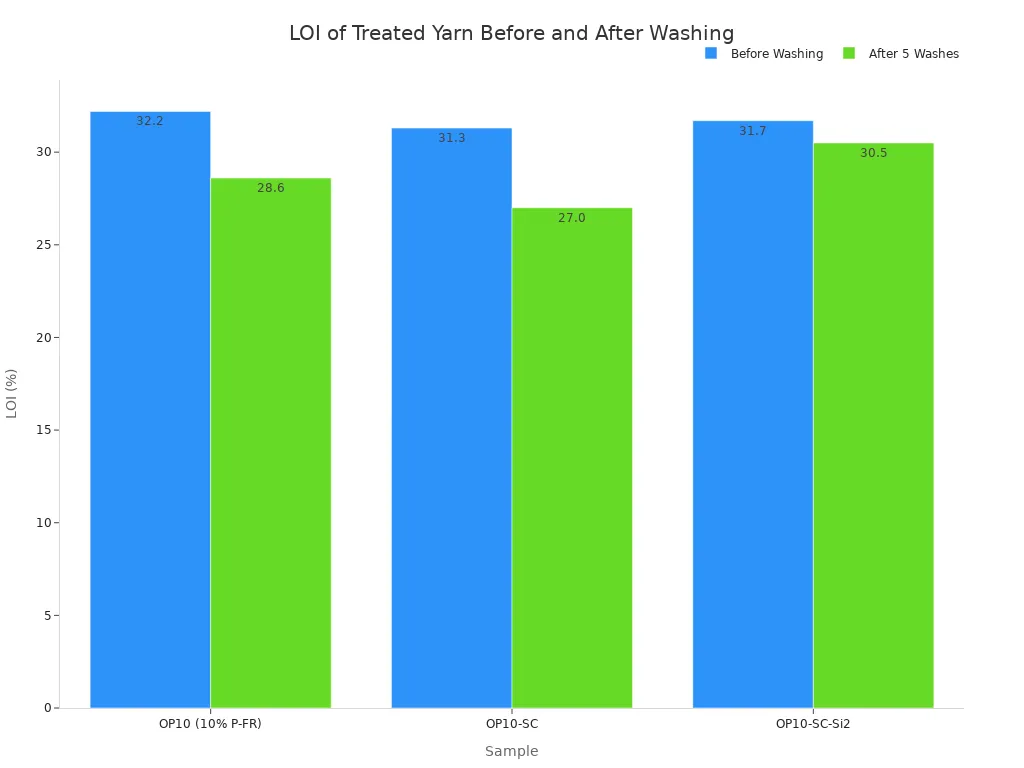
All treated samples achieve LOI values above 30 percent, significantly exceeding the untreated baseline. The OP10-SC-Si2 formulation retains the highest flame resistance after five washes at 30.5 percent, demonstrating excellent durability of the treatment. This performance makes your yarns suitable for protective clothing, upholstery, and industrial applications where fire safety regulations demand strict compliance.
Antimicrobial and UV Protection
Silver nanoparticles incorporated into the inorganic powder for yarn provide lasting antimicrobial functionality. Testing demonstrates that wool yarn treated with silver nanoparticles and dyed with natural extracts maintains high efficacy after repeated washing.
Sample (Wool-Ag dyed with) | Washing Cycles | Antibacterial Activity (%) – E. coli | Antibacterial Activity (%) – S. aureus |
|---|---|---|---|
Roots of Berberis | 10 | 80.23 | |
Stems of Berberis | 10 | 78.40 | 72.17 |
The root-dyed sample achieves 84.69 percent efficacy against E. coli after ten washes, exceeding the 84 percent threshold for practical antimicrobial protection. This durability makes the treatment suitable for medical textiles, sportswear, and activewear where odor control and hygiene are critical selling points. The same inorganic particles also provide UV protection, shielding the wearer from harmful radiation during outdoor activities. These functional benefits persist through the product’s lifetime, adding value without requiring additional finishing steps.
Cost and Eco-Benefits of BANDě Powder
Longer Lifespan and Reduced Waste
Enhanced durability directly lowers your total production costs. When yarns resist breakage and abrasion, you waste fewer materials during manufacturing. Fewer thread breaks mean less downtime on your weaving and knitting lines. Each interruption costs you labor hours and machine idle time. The inorganic powder for yarn reduces these disruptions substantially. Your finished products also last longer in service. End users replace textiles less frequently, which reduces their long-term expenses. For bulk buyers, this translates into a clear return on investment. You pay a modest premium per kilogram of treated yarn. You recover that cost through reduced waste, fewer defects, and stronger customer retention. Consider a weaving operation processing ten tons of yarn monthly. A 5 percent reduction in breakage-related waste saves hundreds of kilograms of material each month. Those savings accumulate quickly across annual production cycles. The durability advantage also strengthens your brand reputation. Customers associate your products with reliability and extended service life.
Sustainable Production and Recyclability
BANDě manufactures its inorganic powder through processes designed for minimal environmental impact. The production methods consume less energy than conventional additive manufacturing. You also reduce chemical usage during textile finishing because the powder integrates directly into the yarn matrix. This eliminates separate treatment steps that require additional water, energy, and chemical agents. The sustainability benefits extend beyond production. Yarns containing this powder remain fully recyclable at the end of their service life. You can process them through standard textile recycling streams without special handling. This compatibility supports circular economy goals that increasingly matter to your customers and regulators. Many brands now require suppliers to document environmental performance. Choosing BANDě powder helps you meet those requirements with verifiable data. The combination of lower energy input, reduced chemical load, and full recyclability positions your products favorably in sustainability assessments. These advantages matter commercially. Procurement teams increasingly weigh environmental metrics alongside price and performance. BANDě powder lets you compete effectively on all three dimensions simultaneously.
Real-World Applications in Textiles
Industrial and Technical Yarns
You will find BANDě-treated yarns performing reliably in demanding industrial environments. Conveyor belts require exceptional tensile strength and abrasion resistance to withstand continuous operation. The inorganic powder for yarn reinforcement prevents premature failure, extending belt service life significantly. Protective clothing for firefighters and chemical workers demands both thermal stability and flame retardancy. Treated yarns maintain their structural integrity even when exposed to intense heat sources. Automotive textiles present another critical application area. Seat belts, airbags, and interior fabrics must meet strict safety standards while resisting wear from constant use and UV exposure. The antimicrobial properties prove essential in vehicle interiors, where temperature fluctuations create conditions for bacterial growth. Industrial filtration systems also benefit from the enhanced durability, as filter media must maintain dimensional stability under repeated cleaning cycles.
Consumer and Specialty Textiles
Sportswear manufacturers choose treated yarns for their dual performance and comfort advantages. Antimicrobial protection controls odor-causing bacteria, keeping activewear fresher between washes. The UV protection transforms ordinary garments into effective sun shields. Untreated cotton and linen fabrics offer minimal protection with UPF ratings below 15. Their loose weave allows significant UV penetration. Inorganic-powder-treated fabrics achieve UPF ratings of 40 to 50+, blocking over 97.5 percent of harmful radiation. Research demonstrates that cotton treated with just 2 percent zinc oxide nanoparticles reaches a UPF of 71. These particles scatter, absorb, and reflect UV radiation efficiently at low loadings.
Outdoor gear manufacturers rely on this technology for tents, backpacks, and technical outerwear. The combination of durability and UV protection ensures equipment withstands harsh environmental conditions. Home furnishings also benefit from treated yarns. Upholstery fabrics resist fading from sunlight exposure while maintaining their appearance through years of use. The antimicrobial finish adds value to bedding and curtains, creating healthier living environments. These consumer applications demonstrate how BANDě’s technology delivers tangible benefits that resonate with end users.
BANDě’s inorganic powder for yarn delivers measurable gains across every performance dimension. You gain mechanical strength, thermal stability, and lasting antimicrobial protection. These benefits reduce production costs and support sustainability goals. Choosing BANDě positions you strategically in competitive markets. The durability advantage strengthens your brand reputation. Explore product specifications or request samples for testing today.
FAQ
Does the powder change the yarn’s texture?
The micro-particles reinforce fibers at the molecular level. The yarn maintains its flexibility and drape for textile applications.
Are these yarns safe for skin contact?
Yes. Medical textiles and sportswear use these antimicrobial yarns. The inorganic powder is chemically stable and non-irritating.
Can you use treated yarns on existing machinery?
Yes. The reinforcement reduces breakage during weaving and knitting. You need no special modifications to your equipment.
See Also
The Complete 2025 Handbook For BANDě Mineral Plaster
Inorganic Versus Organic Wall Coatings: A 2025 Deep Dive
Achieve Durable Surfaces With Inorganic Anti-Alkali Primer
Comparing Industrial Floor Hardeners: A 2025 Guide
Discover Inorganic Anion Wall Paint For Healthier Homes In 2025
