


You often feel confused by concrete hardener, densifier, and sealer. Many believe these products penetrate deeply, but a water-based concrete floor hardener reacts with calcium hydroxide near the surface. This article clarifies their distinct roles and benefits for effective concrete protection. We introduce each as a unique solution for enhancing your concrete.
Key Takeaways
Concrete hardeners strengthen fresh concrete, densifiers toughen cured concrete internally, and sealers block surface moisture and stains.
You can combine hardeners, densifiers, and sealers to create complete long-lasting protection for your concrete floors.
Choose your concrete treatment based on traffic levels, chemical exposure, overall budget, and current floor condition.
Concrete Hardeners: What They Are
Defining Concrete Hardeners
Concrete hardeners are products you apply to fresh concrete surfaces to make them stronger. These products enhance the inherent strength of the concrete. Liquid concrete floor hardeners primarily rely on silicate compounds as their active ingredient. These compounds often come from lithium, potassium, or sodium formulations. You can also find active chemical carrying agents like sodium, potassium, lithium, and other specialized hardening agents in densification products. Hardeners fall into categories like inorganic, organic, and hybrid. Inorganic hardeners use sodium silicate, potassium silicate, magnesium fluorosilicate, nano silica, and aluminum oxide. Organic hardeners combine epoxy resin, polyurethane, or acrylic with curing agents and hard mineral fillers. Hybrid hardeners blend inorganic silicates and organic resins, sometimes with reinforcing fibers.
How Hardeners Work
A water-based concrete floor hardener is a milky white liquid. It penetrates the surface of your concrete, reacting rapidly with the ions within the concrete. This process promotes the re-hydration heat reaction of the concrete. It builds a three-dimensional network structure in multi-dimensional space. This network helps build the overall structural framework of the floor surface. It also increases the overall supporting strength. This product is a water-soluble inorganic compound. The chemical transformation happens when specific compounds dissolve in water. They interact with free calcium carbonate within the concrete. This reaction creates a Calcium-Silicate-Hydrate (C-S-H) gel through its interaction with silicate ions. This mechanism drives the hardening and densification of the material. A high-quality liquid hardener ensures this process is effective.
Benefits of Hardeners
Using a hardener offers several key benefits for your concrete. You will see increased surface hardness and improved abrasion resistance. This enhances the overall durability of your concrete surfaces. These products also help reduce dusting, making your floors cleaner and easier to maintain. The performance of concrete hardeners is often measured against industry standards. These include ASTM C779, ASTM F150, ASTM F609, and ASTM G155. Wear resistance testing, like Taber Abrasion, also confirms their effectiveness. Many products also meet environmental and safety certifications, including North American VOC regulations and USDA acceptance for treated surfaces.
Hardener Applications
Hardeners are essential for various applications where you need robust concrete. They are ideal for industrial floors, warehouses, and manufacturing facilities. These are high-traffic areas that demand superior hardness and resistance to wear. For example, lithium densifiers require only a light surface application. Sodium and potassium densifiers, like Ashford Formula, need full surface saturation with continuous agitation. You then thoroughly remove residue before crystallization. Equipment like large ride-on auto scrubbers can apply water, agitate the chemical, and vacuum dirty residue in one pass. These ideal applications ensure your concrete achieves maximum strength and longevity. A water-based concrete floor hardener is a versatile solution for many environments.
Concrete Densifiers: What They Are
Defining Concrete Densifiers
You apply concrete densifiers to cured concrete. They soak in to fill tiny holes and increase density. The primary active compounds in concrete densifiers include reactive silica (SiO2). This is the core active element delivered into the cement paste. Soluble alkali carriers keep the silica in a soluble liquid state. These include lithium, sodium, potassium, and colloidal silica (Nano Silica). The three main chemical composition categories for concrete densifier products are sodium silicate, lithium silicate, and potassium silicate.
How Densifiers Work
A concrete densifier soaks into the slab. It enhances abrasion resistance, surface hardness, and durability without altering the surface appearance. Applying a high-quality densifier can increase overall concrete strength by 40-50 percent. Densifiers consist of reactive silicate liquids. They soak into concrete surfaces. Upon penetration, they engage in a chemical reaction with unbonded calcium hydroxide. This generates calcium silicate hydrate (CSH), which permanently strengthens the surface structure. Introducing silicate densifiers to calcium hydroxide alters the weaker, porous components of the slab into a solid, binding CSH gel. This reaction permanently consolidates the cement matrix at the surface level.
Benefits of Densifiers
Using a densifier offers many benefits for your concrete. You get increased durability and improved surface hardness. This enhances the overall longevity of your concrete surfaces. Densifiers also provide better stain resistance and reduce dusting. They improve the overall appearance of your concrete without forming a surface film.
Densifier Applications
Densifiers are ideal for many applications where you need robust concrete. They are perfect for high-traffic areas like warehouses, industrial floors, and retail spaces. These environments demand superior hardness and resistance to wear. Your concrete surfaces will benefit from the increased durability a densifier provides.
Concrete Sealers: What They Are
Defining Concrete Sealers
You use concrete sealers to create a protective layer on top of your concrete surfaces. This product does not penetrate deeply like densifiers. Instead, a sealer forms a barrier. This barrier shields the concrete from various external threats.
How Sealers Work
A concrete sealer protects against external elements. It prevents water, moisture, and stain penetration. This reduces the risk of water damage, cracking, and spalling. You can find different types of concrete sealers.
Epoxy Sealers: These are impervious, high-gloss coatings. You use them for industrial interior chemical control.
Polyaspartic Sealers: These cure quickly. They allow for short return-to-service times and fast recoating.
Silicate Sealers: These penetrate and react chemically with concrete. They form calcium silicate hydrate (C-S-H) for surface densification.
Silane and Siloxane Sealers: These penetrate below the surface. They provide water repellency for exterior concrete.
Silicone Sealers: You use these for temporary water repellent protection. They do not chemically bond to cement paste.
Hybrid Urethane-Acrylic Systems: These offer a balance of moisture tolerance and moderate durability.
Acrylics: These are topical coatings. They offer moderate protection against stains and acids. They give a natural to high gloss finish.
Urethanes / Polyurethanes: These topical products offer strong scratch, stain, and acid resistance.
Fluoropolymers: These penetrating formulations fill concrete pores and repel liquids.
Wax: You use wax as a sacrificial layer over primary coats.
Benefits of Sealers
Using a concrete sealer offers many benefits for your concrete. You get excellent moisture protection and stain protection. This helps maintain the concrete’s appearance. A good product also extends the life of your concrete. It prevents damage from spills and weather.
Sealer Applications
You apply sealers in many places. They are great for garage floors, patios, and driveways. Any area needing defense from spills or weather can benefit. The lifespan of a sealer varies.
Sealer Category | Expected Lifespan | Impact of Environmental & Physical Conditions |
|---|---|---|
Water Repellent Penetrating Sealers | 5 to 7+ years | Longevity depends on physical wear, weathering, and whether applied indoors or outdoors. |
Densifiers & Hardeners | 10+ years | Highly durable; lifespan varies based on interior vs. exterior exposure and usage wear. |
Standard Topical Sealers (e.g., Acrylics) | 1 to 3 years | Highly susceptible to weather and traffic. Outdoor uses sit at the 1-year mark, while indoor uses reach up to 3 years. |
Heavy-Duty Topical Sealers / Coatings | Up to 5 years | Subject to surface abrasion and climate exposure; professional-grade coatings can last 5–7+ years. |
You can see the typical expected lifespan for different categories of concrete sealers in the chart below. This shows how different products perform over time.
Hardener vs. Densifier vs. Sealer: Key Differences
Understanding the core distinctions between hardeners, densifiers, and sealers helps you choose the right product for your concrete. Each product interacts with your concrete in a unique way.
Penetration vs. Surface Layer
The most significant difference lies in how these products interact with your concrete. You apply a water-based concrete floor hardener to the surface. It reacts with the concrete ions to build a stronger surface layer. A liquid hardener primarily works on the top layer.
A concrete densifier, however, penetrates deeply into the concrete slab. It fills tiny holes and increases the material’s density from within. While standard densifiers offer deep substrate penetration, specific formulas like colloidal silica feature constrained penetration depth. These primarily reinforce the near-surface zone.
A sealer works differently. It creates a protective layer on top of your concrete surfaces. Sealers differ by chemical makeup. Options like silane and siloxane seep into the upper concrete matrix to stop moisture. Coatings like epoxies remain entirely on top.
Here is a quick overview of their penetration characteristics:
Product Type | Penetration Characteristics | Action Mechanism |
|---|---|---|
Concrete Hardener | Minimal (Surface level) | Builds a protective film layer over the top surface |
Concrete Densifier | Deep substrate penetration (Colloidal silica variants mostly target near-surface layers) | Infiltrates concrete to generate CSH gel, filling internal pore structures |
Concrete Sealer | Varies by composition (e.g., Silane/Siloxane penetrate, Epoxy forms surface film) | Penetrates beneath the surface to block water or forms an exterior barrier layer |
Application Timing: Fresh vs. Cured
You apply hardeners to fresh concrete surfaces. This helps them become strong from the start. Densifiers and sealers, on the other hand, typically go on cured concrete. You apply a densifier to an existing slab to enhance its properties. You also apply a sealer to cured concrete to add a protective barrier.
Primary Function and Protection
Each product serves a distinct purpose for your concrete. A water-based concrete floor hardener primarily increases the overall supporting strength and hardness of the concrete. It makes the surface more robust.
A densifier focuses on increasing the density and abrasion resistance of your concrete. It makes the concrete stronger from within, improving its overall durability. This internal strengthening helps your concrete withstand heavy use.
A sealer provides external protection. It shields your concrete surfaces from water, moisture, and stains. This protection reduces the risk of water damage, cracking, and spalling. It acts as a barrier against environmental elements.
Impact on Appearance and Longevity
The impact on appearance varies significantly among these products. A densifier generally does not alter the appearance of your concrete. It enhances the internal structure without changing the surface look. This means you get increased hardness and durability without a visible coating.
A sealer, however, can change the appearance of your concrete. Some sealers provide a glossy finish, while others offer a matte look. They can also enhance the color of your concrete, giving it an enhanced appearance. Beyond aesthetics, a sealer significantly extends the lifespan of your concrete by protecting it from external damage.
Hardeners improve the overall strength and hardness of the concrete. This contributes to its long-term durability and longevity. You get a stronger, more resilient concrete surface that lasts longer.
Can They Be Used Together
You might wonder if you can use hardeners, densifiers, and sealers together. The answer is often yes! Combining these products can offer superior protection for your concrete floors. Each product plays a distinct role, and when you apply them correctly, they create a comprehensive defense system. This layered approach enhances the overall durability and longevity of your concrete.
Synergistic Benefits of Combined Use
When you combine these products, you unlock powerful synergistic benefits. A hardener strengthens the surface of fresh concrete, making it more resilient from the start. A densifier then penetrates deeper into the cured concrete, filling pores and increasing its internal density. This makes the concrete much harder and more resistant to abrasion. Finally, a sealer forms a protective barrier on top. This barrier shields your concrete from external threats like moisture, stains, and chemicals. You get a floor that is not only internally strong but also externally protected. This combination provides a robust solution for high-traffic areas or environments needing maximum protection.
Recommended Application Order
The order in which you apply these products is crucial for their effectiveness. You should follow a specific sequence to ensure each product performs its best.
Hardener (for fresh concrete): If you are working with new concrete, apply the hardener first. This product helps the concrete cure stronger and harder from the beginning.
Densifier (for cured concrete): Once the concrete is cured, or if you are treating an existing slab, apply the densifier. The densifier soaks into the concrete, reacting to increase its internal strength and density. You allow the densifier to fully cure and react before moving to the next step.
Sealer: After the densifier has done its job and the surface is clean and dry, you can apply the sealer. The sealer creates the final protective layer on the surface. This layer guards against spills and wear.
This sequence ensures that the internal strengthening happens before the external protection is applied. You build strength from the inside out, then protect the exterior.
When Not to Combine Products
While combining these products offers many advantages, there are times when you might not need all three. You should consider your specific project needs and the condition of your concrete.
Existing High-Strength Concrete: If your concrete already possesses excellent strength and density, adding a hardener or a densifier might be unnecessary. You might only need a protective sealer.
Low-Traffic Areas: For areas with very light foot traffic and minimal exposure to spills, a simple sealer might provide adequate protection. You do not always need the added expense and effort of a full hardener and densifier treatment.
Specific Aesthetic Goals: Some sealers can alter the appearance of your concrete, adding a gloss or enhancing color. If you desire a completely natural, unaltered look, you might choose a penetrating densifier alone and forgo a topical sealer.
Product Incompatibility: Always check the compatibility of different products from various manufacturers. Some formulations might not work well together, potentially leading to adhesion issues or reduced effectiveness. You should consult product data sheets or manufacturers’ recommendations to avoid problems.
You make the best decision by assessing your concrete’s current state, its intended use, and your budget.
Choosing the Right Concrete Floor Solution

You need to make informed decisions when you select a concrete floor solution. Consider several factors to ensure you pick the best option for your specific needs.
Assessing Your Concrete’s Needs
First, you must evaluate your concrete’s current condition. You assess its existing hardness and porosity. Industry standards help you with this. For example, ASTM F3191-16 determines substrate water absorption, and ASTM F710-21 mandates porosity evaluation for all concrete slabs. You can also measure surface hardness and strength. The Rebound Hammer Test evaluates surface hardness by measuring rebound velocity. ASTM C803 uses a powder-actuated driver to test penetration resistance. Understanding these parameters helps you choose the right product to improve your concrete’s durability and overall appearance.
Standard Code | Evaluated Parameter | Requirement / Scope |
|---|---|---|
ASTM F3191-16 | Substrate Water Absorption / Porosity | Serves as the field standard practice to determine substrate surface water absorption prior to applying resilient flooring. |
ASTM F710-21 | Substrate Porosity Assessment | Mandates surface porosity evaluation for all concrete slabs receiving resilient flooring, regardless of slab age or elevation. |
Test / Standard | Evaluated Parameter | Method Summary |
|---|---|---|
Rebound Hammer Test | Concrete Surface Hardness & Strength | Evaluates surface hardness by measuring the rebound velocity (R-number) of a spring-driven hammer striking the concrete. |
ASTM C803 | Penetration Resistance (Hardness/Strength) | Utilizes a powder-actuated driver to drive a steel probe with a conical tip into the surface. |
Considering Traffic and Exposure
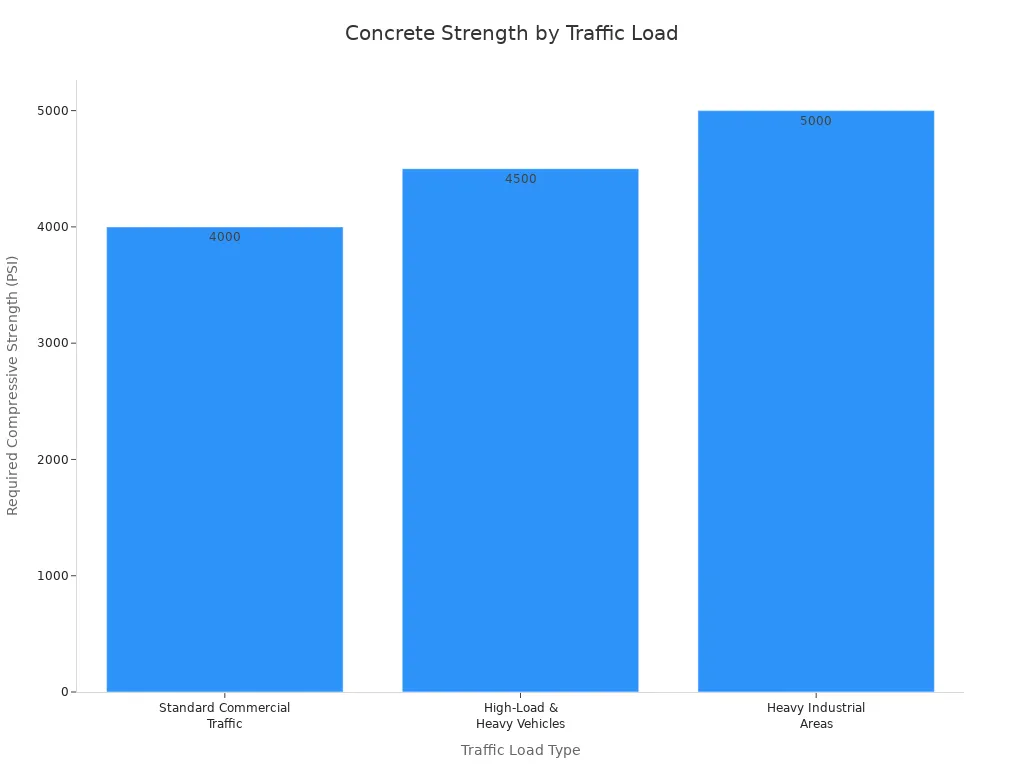
You must also think about the traffic your concrete will endure and the chemicals it might encounter. High-traffic areas, like warehouses or industrial facilities, demand solutions that provide superior hardness and protection. For instance, heavy industrial areas require concrete with 5,000+ PSI compressive strength.
Application / Traffic Load Type | Required Compressive Strength (PSI) | Specific Load & Vehicle Considerations |
|---|---|---|
Standard Commercial Traffic | Minimum 4,000 PSI | General vehicular movement and standard commercial access |
High-Load & Heavy Vehicles | 4,000 – 5,000 PSI | Delivery trucks, heavy service vehicles, and high-load stress cycles |
Heavy Industrial Areas | 5,000+ PSI | Loading docks, drive lanes, and high-fatigue industrial sites |
Chemical exposure also plays a big role. Manufacturing centers face industrial acids, while residential garages see motor oil and road salt. A concrete sealer or a concrete densifier can offer specific resistance.
Environment / Facility Type | Exposed Chemical Categories | Specific Chemical Examples |
|---|---|---|
General Industrial & Commercial | Acids, Bases, Solvents, Fuels, Cleaners | Sulfuric acid, nitric acid, hydrochloric acid, alkalis, acetone, xylene, MEK, gasoline, diesel, disinfectants, de-icing salts |
Food Processing Plants | Organic Acids, Cleaning Agents | Acidic juices, industrial cleaners |
Automotive & Transport Facilities | Automotive Fluids, Solvents | Motor oil, gasoline, brake fluid, various solvents |
Restaurants & Hospitality (Back-of-House) | Food Compounds, Maintenance Chemicals | Hot oils, degreasers, acidic sauces, mopping solutions |
Budget and Long-Term Goals
Your budget and long-term goals also guide your choice. Investing in the right solution initially can lead to a longer lifespan for your concrete. You save money on repairs and replacements over time. Consider the desired appearance and the overall lifespan you expect from your concrete surfaces.
You now understand hardeners strengthen fresh concrete. Densifiers increase internal concrete density. A sealer protects the surface. Your best choice depends on project needs, desired durability, and concrete condition. Evaluate your specific requirements. Consider professional advice for lasting concrete protection.
FAQ
Can I apply a sealer over a densifier?
Yes, you can. Apply the sealer after the densifier has fully cured. This provides both internal strength and external protection for your concrete.
How do I know if my concrete needs a hardener or a densifier?
You use a hardener on fresh concrete to strengthen it. You apply a densifier to cured concrete to increase its internal density and abrasion resistance.
Do hardeners and densifiers change the look of my concrete?
Generally, no. Hardeners and densifiers work internally to strengthen your concrete without altering its surface appearance. Sealers can change the look.
See Also
Understanding How Concrete Densifiers, Hardeners, And Sealers Protect Surfaces
A Complete Guide To Concrete Floor Hardeners And Functions
Essential Facts You Need To Know About BANDe Hardeners
The Ultimate Buyer Guide For Concrete Densifiers And Sealers
How Industrial Floor Hardeners Work To Enhance Surface Durability
