


High-performance floor hardener systems enhance concrete durability and longevity in industrial and commercial settings. Demand for robust flooring solutions grows. Two primary categories exist: dry shake hardeners and liquid floor hardeners. These dry and liquid options offer distinct approaches to superior floor hardener performance, guiding the selection of the best dry solution.
Key Takeaways
Dry shake hardeners offer maximum strength and durability for fresh concrete in heavy industrial settings.
Liquid hardeners seal concrete pores to prevent dust and fit light traffic or existing floor upgrades.
Choose dry shake hardeners for heavy machinery traffic or liquid hardeners for easier low-cost maintenance.
Dry Shake Floor Hardeners: Composition and Benefits
Material Makeup and Application
Dry shake hardeners are factory-blended, cementitious materials. They contain a cementitious binder, aggregates, admixtures, and other additives. These dry shake hardeners may also include inorganic pigments or natural coloring for aesthetic purposes. The aggregate component can be 100% of one group or a blend of several groups, influencing performance, appearance, and color. Common aggregate types include natural quartz, synthetic non-metallic mineral aggregates, and metallic or metallic alloy aggregates. These materials are specifically designed for industrial settings that demand maximum surface strength, impact resistance, and customization.
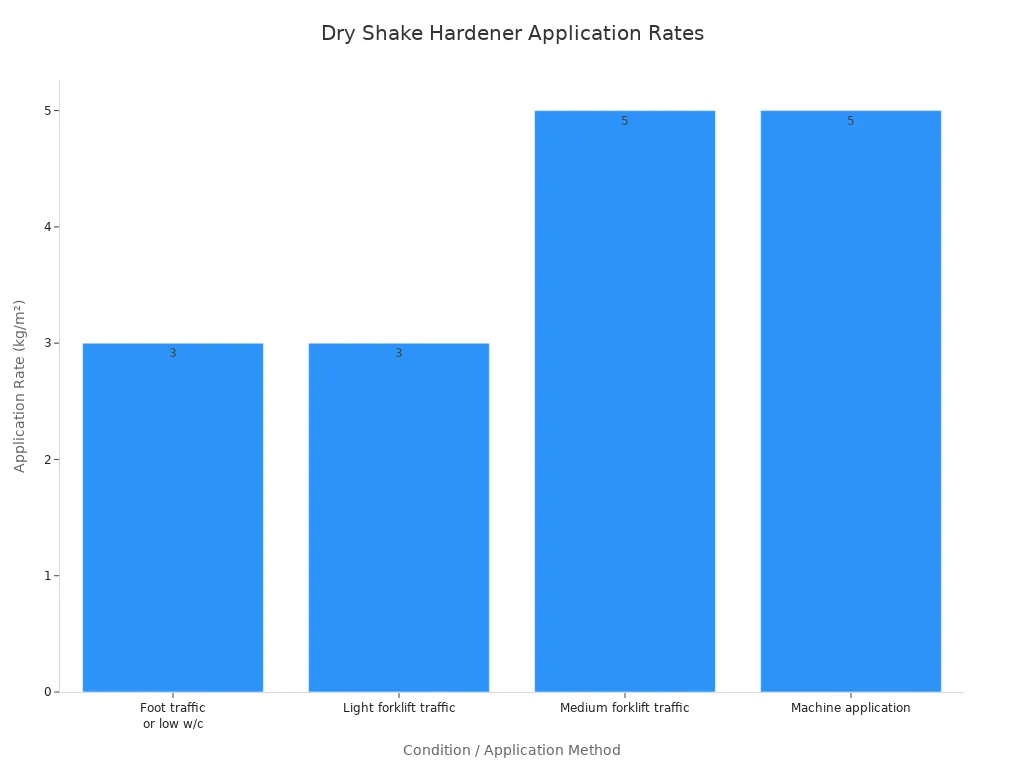
Application of these dry-shake hardeners occurs on freshly placed concrete. Sufficient free water must be present at the concrete surface for the dry shake to fully wet and integrate monolithically into the base concrete. Installers can apply the dry-shake hardener by hand after the concrete begins to set, or by machine immediately after placement. The finished layer thickness typically ranges from 2 to 3 mm. For foot traffic or light forklift use, an application rate of 3 kg/m² is common. Medium forklift traffic requires 5 kg/m², while heavy forklift traffic needs 5–7 kg/m². Pigmented dry shake hardeners require a minimum of 6 kg/m². Hand application usually involves 4–5 kg/m², or up to 7 kg/m² in two steps. Machine application works best at 5 kg/m²; lower rates risk aggregate sinking. This process ensures the hardener effectively improves wear resistance, reduces dusting, and lowers surface permeability for new concrete pours.
Enhanced Concrete Durability and Strength
The hardening mechanism of dry shake hardeners relies on the cementitious binder. This binder hydrates using the free water present at the fresh concrete surface. This process reduces the near-surface water-cement ratio, which in turn produces a dense, abrasion-resistant surface. This densification significantly enhances the concrete’s durability and strength, making it suitable for heavy-duty industrial floors and high-traffic areas. The selection of the right dry-shake hardener depends on service conditions, desired durability, aesthetics, and cost. Abrasion resistance serves as the recommended comparison guide for industrial flooring.
Different aggregate types contribute to the enhanced strength of dry shake concrete hardeners. Natural aggregates like quartz improve concrete surface hardness and abrasion resistance. Metallic aggregates, such as iron, also significantly improve surface hardness and abrasion resistance. For specific applications, non-oxidizing metallic aggregate, formulated to resist oxidation, provides similar benefits without the risk of rust. A dry-shake metallic aggregate floor hardener offers superior impact resistance and longevity, crucial for warehouse flooring and other demanding environments. This robust flooring solution ensures long-term performance under severe conditions.
Liquid Floor Hardeners: Mechanism and Advantages
Chemical Action and Surface Penetration
Liquid floor hardeners primarily function by penetrating and densifying the concrete surface. These solutions, often silicate-based, react chemically with components within the concrete. For instance, lithium silicate liquid hardeners contain lithium ions that keep the silicate in solution. This allows the liquid to travel deeply into the concrete before reacting. Inside the concrete pores, the soluble silicate reacts with calcium hydroxide, also known as free lime. This reaction forms calcium silicate hydrate (CSH), the same binder that gives concrete its strength. The lithium or other alkali metal is not the active hardening ingredient; the beneficial product is the CSH formed by this reaction.
Different formulations of liquid hardeners exist, each with unique characteristics. Sodium/potassium silicates are true solutions of silicate salts in water. They deliver silicate plus mineral salts but can raise pH and cause surface bloom. Lithium silicates, with their smaller molecules, penetrate deeper and react more evenly, minimizing whitening. Colloidal silica, a colloidal dispersion of nanoscale silica particles, offers even greater penetration and does not leave mineral-salt deposits. Ultra-pure nano-sol lithium series formulations, for example, penetrate deeper, react quickly, and fill pores, improving concrete properties significantly. This chemical action effectively solidifies the concrete surface, reducing permeability and making the concrete more stain-resistant.
Key Benefits and Practical Uses
Liquid floor hardeners offer several key benefits, making them a practical and cost-effective solution for many environments. They significantly improve abrasion resistance and reduce dusting. The CSH crystals formed by the reaction fill pores, increasing hardness and eliminating dusting by sealing the concrete surface. This makes the floor dustproof. Liquid hardeners are suitable for commercial and light industrial facilities, including automated storage and retrieval system warehouses, high-frequency logistics centers, and existing concrete floors undergoing renovation.
These hardeners provide an increased Mohs hardness of 7–8, which reduces surface flaking. They offer excellent dust control by sealing pores, achieving dust-free floors. Furthermore, liquid hardeners enhance stain and impermeability resistance, helping prevent oil or fluid penetration. They require near-zero maintenance, with no waxing or special treatment needed. The deep penetration, typically 3–8 mm, strengthens the concrete internally. When combined with other hardeners, a liquid floor hardener can extend the floor lifespan, often exceeding 20 years. This makes a liquid hardener an efficient choice for less demanding environments where a robust, low-maintenance floor is essential.
Comparing Performance and Durability
Surface Hardness and Wear Resistance
Comparing the initial surface hardness of concrete treated with different hardeners reveals significant differences in performance and durability. Dry shake hardeners provide two to five times greater surface hardness than standard concrete treated only with liquid hardener, depending on the aggregate type. This enhanced performance also doubles abrasion resistance. The wear layer from a dry-shake hardener is typically 2–4 mm thick, offering greater depth and durability than liquid densifiers. This makes dry shake hardeners a high-performance floor hardener solution.
This superior initial hardness directly translates to overall wear resistance, especially in high-traffic industrial environments. Dry shake hardeners offer high impact and abrasion resistance. They can at least double the concrete surface’s abrasion resistance, acting as a hard protective layer against heavy loads and forklift traffic. Dry-shake hardener often lasts longer under high-stress conditions, maintaining integrity for many years with less frequent repair or replacement. This makes dry shake hardeners preferred for industrial and warehouse floors, high-traffic areas, and outdoor or extreme use. A dry-shake hardener forms an extremely hard protective shield on the warehouse floor, capable of withstanding high-intensity shear forces from forklift wheels. It is applied during concrete pouring, which eliminates the need for a second mobilization and makes it the classic solution for industrial warehouses.
Industry benchmarks like ASTM C627 (Robinson floor test) and ASTM C779 evaluate the abrasion and wear resistance of concrete floor hardeners. ASTM C779 has three procedures: A (revolving steel disks with abrasive grit), B (rotating steel dressing wheels to simulate wheel/caster traffic), and C (steel ball bearings for high-impact/high-stress resistance). Independent testing for Duro-Nox liquid hardeners used Procedure B because it simulates forklift, cart, and dolly traffic. While liquid hardeners like Duro-Nox can improve abrasion resistance by up to 500% at 15 minutes compared to untreated concrete, dry shake hardeners create a tougher, denser surface, significantly improving wear resistance. A liquid hardener offers good densifying effects and surface durability, but its relative wear resistance is lower than that of a dry-shake hardener.
Compressive Strength and Water Absorption
The densification process from both dry and liquid hardeners contributes to improved concrete properties. Dry shake hardeners, by reducing the near-surface water-cement ratio, produce a dense, abrasion-resistant surface. This densification enhances the concrete’s overall strength and contributes to long-term durability. The dry application method ensures the hardener integrates monolithically with the fresh concrete, creating a robust top layer.
Liquid hardeners, through their chemical reaction with calcium hydroxide, form additional calcium silicate hydrate (CSH) within the concrete pores. This process densifies the surface, which improves compressive strength and reduces porosity. Reduced porosity means lower water absorption, making the concrete more resistant to moisture penetration and chemical attack. This contributes to an extra-long lifespan for the treated floor. While a dry-shake hardener provides a thicker, more robust wear layer, the internal strengthening from a liquid hardener also extends the floor’s lifespan. Both types of hardener contribute to a more resilient concrete surface, but the dry method typically offers superior initial surface hardness and wear resistance for the most demanding applications.
Application, Cost, and Aesthetics
Installation Process and Project Impact
The installation process for dry-shake floor hardeners directly impacts project timelines and labor. Installers apply dry-shake hardener to freshly placed concrete. The concrete must reach a plastic stage, allowing slight indentation while remaining workable. First, workers evenly spread about two-thirds of the recommended dry-shake hardener, either by mechanical spreader or by hand. They then work this initial application into the surface using a bull float or a power trowel with float blades until the concrete moisture saturates the dry material.
Next, workers apply the remaining one-third of the dry hardener evenly across the surface. They float the surface again to incorporate this second application. Once the concrete hardens sufficiently, workers smooth and compact the surface with a power trowel using finish blades, often requiring multiple passes. Finally, they cure the floor for the recommended period, typically 7–14 days, by keeping it moist with plastic sheeting or a curing compound. This dry application method integrates the hardener monolithically with the concrete, creating a durable industrial surface.
Investment, Maintenance, and Finish
The investment in a floor hardener varies between dry-shake and liquid options. Dry-shake hardeners generally involve a higher initial material cost and more labor-intensive application during the concrete pour. However, their superior durability often translates to lower long-term maintenance and replacement costs, especially for heavy-duty industrial and warehouse flooring. Liquid hardeners typically offer a lower initial cost and simpler application, making them a cost-effective solution for less demanding environments. Both types of flooring solutions require minimal ongoing maintenance once cured.
Aesthetic finishes also differ. Dry-shake hardeners, especially colored dry-shake options, can provide a dense, wear-resistant surface with integral color and texture. For example, a dry-shake hardener with a finishing aid can produce a polished, dense surface. Liquid hardeners are crucial for polished concrete systems. After densifying with a liquid hardener, workers polish the concrete with progressively finer diamond grit to achieve flat, satin/matte, polished, or highly polished sheens. Color can be added before or after densification, with the liquid hardener preparing the surface for polishing. This allows for diverse aesthetic outcomes in warehouse flooring and other commercial spaces.
Choosing the Right High-Performance Floor Hardener
Suitability for New vs. Existing Concrete
Selecting the ideal floor hardener depends significantly on the concrete’s current condition. Dry shake hardeners require application to fresh, plastic concrete. Installers broadcast these materials onto the wet surface during the initial stages of a new concrete pour. This method ensures the dry hardener integrates monolithically with the slab, forming a robust, integral surface layer. Consequently, dry shake hardeners cannot be used on existing cured slabs.
Conversely, liquid floor hardeners offer greater versatility. They can treat both new concrete pours and existing concrete floors. For older, worn concrete, liquid hardeners are particularly useful for dustproofing and densifying the surface. This makes them a flexible solution for renovations or for improving the performance of an existing slab without a complete replacement. Therefore, project managers must first assess whether they are working with new construction or an existing structure when choosing a floor hardener.
Project Requirements and Environmental Factors
Facility owners must evaluate several key project factors when choosing between dry shake and liquid concrete floor hardeners for industrial, commercial, or retail facilities. Traffic volume is a critical consideration. Liquid hardeners suit warehouses with light to medium traffic, retail spaces, showrooms, and offices. Dry hardeners are necessary for heavy continuous traffic, manufacturing plants, loading docks, and distribution centers. For impact and abrasion resistance, liquid hardeners reduce dusting and improve abrasion resistance, but their hardening effect is mostly superficial. They do not significantly add impact resistance. Dry hardeners create an integral, tough surface layer with superior abrasion and impact resistance. This makes them a preferred high-performance floor hardener for demanding industrial environments.
Budget considerations also play a role. Liquid hardeners typically have lower material and application costs, making them cost-effective for dustproofing or moderate surface upgrades. Dry hardeners involve a higher upfront cost due to material and skilled trowel work. However, they can lower long-term maintenance expenses in high-wear facilities. The desired lifespan of the flooring also guides selection. Liquid hardeners are good for moderate duty and shorter-term needs, potentially requiring maintenance over time. Dry hardeners are preferred when the floor must withstand harsh conditions for decades, such as in warehouse flooring.
Aesthetics and finish also differ. Liquid hardeners allow for polished concrete, high-gloss finishes, and color customization. Dry hardeners offer integral, fade-resistant color and a consistent industrial finish, with fewer decorative pattern options. Application timing is another factor. Liquid hardeners involve a simple spray or mop application on cured concrete, offering flexibility for renovations. Dry hardeners must be timed with the pour, broadcast, and troweled into wet concrete, requiring skilled labor and precise timing.
Environmental factors significantly affect the performance of both hardener types. High ambient temperatures can accelerate water evaporation during curing, requiring precise timing for dry hardener integration and potentially reducing liquid hardener penetration depth. High humidity creates a highly impermeable top layer with dry hardeners, resisting water penetration. Liquid hardeners penetrate concrete, forming a protective barrier against humidity. Dust, pollution, and chemical exposure are better resisted by the harder, dust-proof surface of dry hardeners. Densified surfaces from liquid hardeners are easier to clean and lower vulnerability to chemicals. Inadequate curing environments, where moisture or temperature is not controlled, can cause dusting, cracking, and delamination in both dry-shake and liquid systems.
Performance criteria for a floor hardener include densification, dustproofing, improved abrasion, chemical, petroleum, and freeze/thaw resistance, burnishability, scratch/peel protection, and wear resistance. Industry standards, such as U.S. VOC regulations (EPA, CARB, SCAQMD) and USDA acceptance, guide product selection. Liquid hardeners generally have a favorable environmental profile, with minimal preparation conserving energy and material. They resist bacteria/mold, water, oil, chemicals, weather, and yellowing. Dry hardeners are long-lasting and low-maintenance in service, but their application phase has higher health and environmental concerns than liquid alternatives due to intensive application demands and higher risk factors.
Dry shake hardeners offer superior abrasion and impact resistance for heavy traffic, ideal for warehouses. These dry shake hardeners require application to fresh concrete. Liquid options, easier to apply on new or existing floors, improve density and reduce dusting. The optimal high-performance floor hardener depends on project needs, budget, and aesthetics. Evaluate these dry and liquid options for a durable concrete floor.
FAQ
Can facility owners apply dry shake hardeners to existing concrete floors?
No, installers apply dry shake hardeners to fresh, plastic concrete during a new pour. They integrate monolithically with the slab.
Which type of floor hardener offers superior surface hardness?
Dry shake hardeners provide two to five times greater surface hardness than concrete treated with liquid hardeners. This significantly enhances wear resistance.
Are liquid floor hardeners suitable for heavy industrial traffic?
Liquid hardeners suit light to medium traffic. Dry hardeners are necessary for heavy continuous traffic, manufacturing plants, and distribution centers.
See Also
How To Choose The Best BANDě Floor Hardener In 2025
Comparing BANDě Concrete Densifiers Versus Dry Shakes For Optimal Flooring
Understanding Industrial Floor Hardeners And How They Protect Concrete Surfaces
A Complete 2025 Buyer Guide To Commercial Grade Floor Hardeners
Everything You Need To Know About Concrete Hardeners And Functionality
